
Why Group Therapy Offers More Than You Think
The benefits of group therapy go far beyond just sharing your story. Research shows you can gain:
- Universality & Belonging: Realizing you're not alone, which reduces isolation and shame.
- New Perspectives: Learning from others' experiences to gain fresh insights.
- Improved Accountability: Staying motivated and committed to your goals with group support.
- Cost-Effectiveness: Typically half to a third the cost of individual therapy while being equally effective.
- Social Skills Development: A safe space to practice communication and receive honest feedback.
- Hope & Inspiration: Witnessing others' progress can jumpstart your own healing.
Let's face it—opening up isn't easy. Yet group therapy is as effective as individual therapy for treating depression, anxiety, PTSD, and many other conditions. What makes it so powerful is the healing that happens through connection. When you hear someone else describe exactly what you've been feeling, that moment of recognition—"I'm not the only one"—can be profoundly liberating.
Group therapy creates a microcosm of the real world, but with a crucial difference: it's a safe space to experiment with new behaviors, receive immediate feedback, and build skills for your everyday relationships. The therapeutic factors at work are well-documented, including altruism (the boost from helping others), interpersonal learning (understanding how you come across), and cohesiveness (a strong sense of belonging).
Our therapists have witnessed the transformative benefits of group therapy firsthand. While individual therapy is powerful, group therapy offers unique advantages that simply can't be replicated in one-on-one sessions, especially when combined with approaches like CBT and DBT.
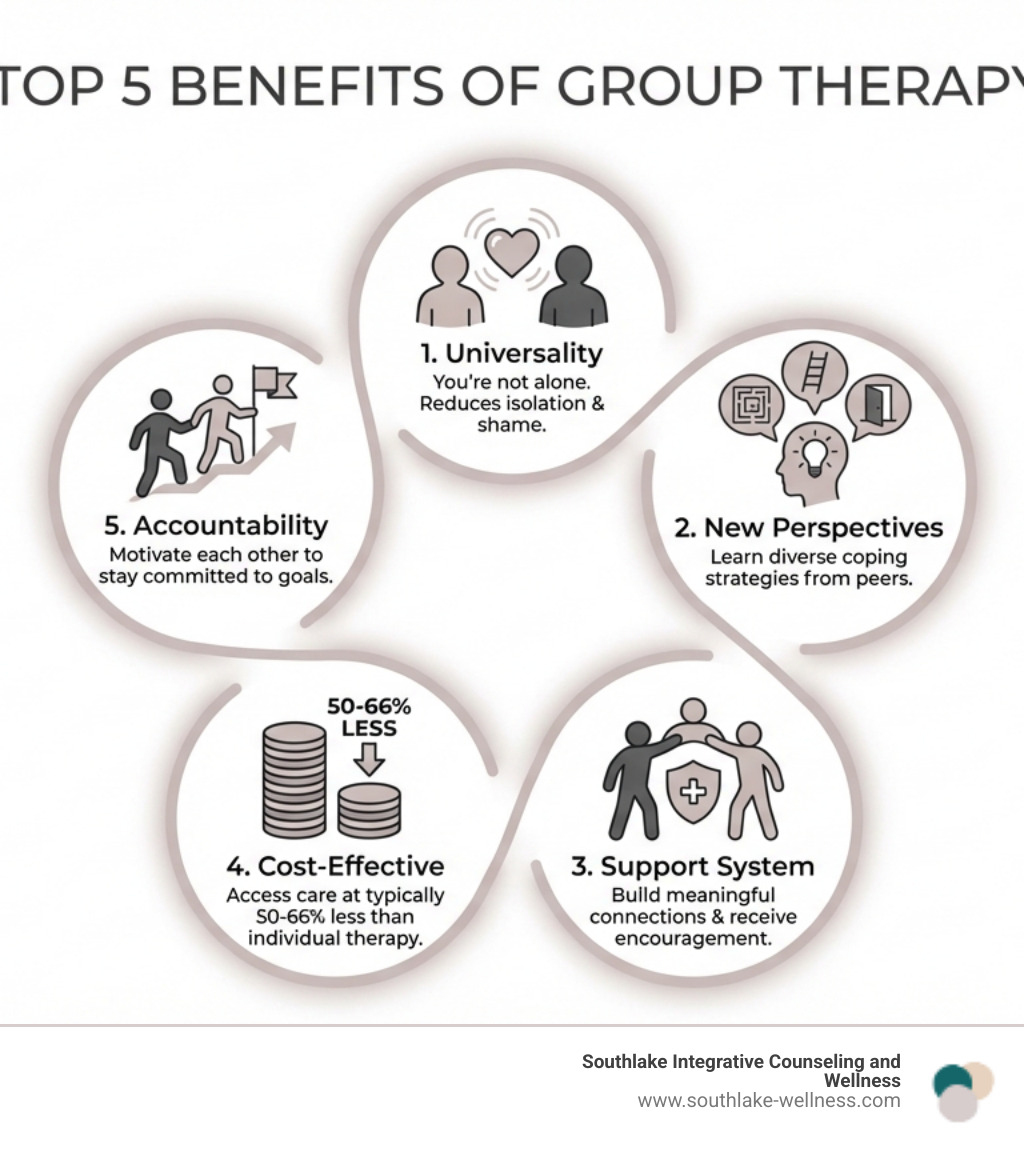
The Core Benefits of Group Therapy: A Community for Healing
There's something magical that happens when people who've felt utterly alone find they're part of a larger story. At Southlake Integrative Counseling and Wellness, we see this change regularly—the moment someone realizes their private struggle is a shared human experience.
Universality: You Are Not Alone
One of the most profound benefits of group therapy is universality. When you're struggling, isolation can make you believe you're the only one who feels this way, piling shame on top of your challenges. In a group, that illusion shatters. Hearing others describe experiences that mirror your own creates an immediate sense of belonging and validation. You stop seeing yourself as damaged and start recognizing your struggles as part of the human condition.
Altruism: Gaining by Giving
In group therapy, you're not just there to receive help—you're there to give it, too. Offering a listening ear, sharing what's worked for you, or validating someone's feelings gives you a sense of purpose. You realize that even in your own struggles, you have wisdom to offer. This boosts self-esteem in a way that receiving help alone cannot.
Social and Relational Benefits of Group Therapy
Think of group therapy as a practice field for real life. It's a safe space to try out new ways of communicating and relating to others. You'll naturally develop social skills by interacting with different personalities, learning when to speak up and when to listen. The feedback you receive is uniquely valuable; unlike friends or family, group members and your therapist offer honest, compassionate perspectives on patterns you might not see in yourself.
This process of interpersonal learning helps you understand how you come across to others and allows you to improve your relationships. For many, the group provides a chance to work through dysfunctional family patterns in a healthier way, learning to trust again under a therapist's guidance.
Personal Growth: The Cognitive Benefits of Group Therapy
The benefits of group therapy extend deep into how you think. When you bring a problem to the group, you get multiple viewpoints that help you gain new perspectives and challenge stuck thought patterns. You'll also learn coping mechanisms from others who have successfully used them in real-life situations, making the techniques more tangible and actionable.
Perhaps most importantly, the instillation of hope is a powerful force. Witnessing others' progress proves that change is genuinely possible. The group acts as a mirror, accelerating self-findy and increased self-awareness by reflecting back aspects of yourself you might not otherwise see. Scientific research on group therapy for anxiety disorders confirms that these mechanisms lead to significant symptom reduction.
Building Momentum in Your Recovery Journey
Recovery isn't a straight line. The structure of group therapy helps you stay motivated. Increased accountability comes from sharing your goals with people who care and will gently check in on your progress. Over time, group cohesion—that sense of unity—becomes a healing force, creating a safety net that encourages you to stick with the process.
Witnessing others' progress provides powerful motivation, creating a positive cycle where everyone's growth inspires the others. Finally, the group offers a safe container for catharsis and emotional release, allowing you to let go of pent-up feelings in a space of empathy and understanding. This combination of support, accountability, and hope creates momentum that carries you forward.
Understanding the Group Therapy Environment
Walking into your first group therapy session can feel intimidating, but the environment is carefully designed to be safe and productive. It's a structured space with professional guidance at every step.
The Therapist's Role and Group Dynamics
In group therapy, the therapist acts as a facilitator, not a director. Their job is to foster meaningful interactions, ensure everyone feels heard, and maintain a safe environment. This includes setting clear ground rules from day one, such as confidentiality, mutual respect, and active participation.
Building group cohesion is a primary goal. It happens through shared vulnerability and empathy. While conflict can be uncomfortable, it's also a valuable learning opportunity. A skilled therapist helps the group steer disagreements constructively, turning potentially tense moments into chances for growth and improved communication skills.
Comparing Group Therapy vs. Individual Therapy
The benefits of group therapy become even clearer when compared to individual therapy:
AspectGroup TherapyIndividual TherapyCostGenerally less expensive (half to a third of the price)Typically higher cost per sessionFocusInterpersonal dynamics, shared experiences, collective problem-solvingDeep dive into individual's thoughts, emotions, and personal historyFeedback SourceDiverse perspectives from peers and therapistPrimarily from the therapistSocial Skills PracticeExcellent opportunity to practice and receive real-time feedback on social interactionsLimited to interaction with therapist; skills practiced outside sessionsUniversalityStrong sense of "you are not alone"Can address feelings of isolation, but without direct peer validationAccountabilityPeer support and shared commitment drive accountabilityPrimarily self-driven, with therapist supportConfidentialityEthical agreement among members, but cannot be legally guaranteedLegally privileged communication between client and therapistPaceMay be slower for deeply personal issues as group dynamic unfoldsCan move at a faster, more focused pace for individual concernsTherapist RoleFacilitator, guide, manager of group dynamicsDirect one-on-one clinician, expert guide
Types and Models of Group Therapy
Not all groups are the same. At Southlake Integrative Counseling and Wellness, we offer different models to fit different needs:
- Psychoeducational groups: Focus on teaching information and practical skills about a specific condition.
- Skills development groups: Provide hands-on practice for techniques like those in DBT (Dialectical Behavior Therapy).
- Cognitive Behavioral Therapy (CBT) groups: Apply CBT principles to identify and challenge problematic thought patterns.
- Interpersonal groups: Focus on the here-and-now relationships within the group to improve external relationships.
- Psychodrama: Uses role-playing to explore scenarios, offering new perspectives and emotional release.
- Support groups: Bring together people with similar challenges (e.g., grief, chronic illness) for mutual encouragement.
- Process-oriented groups: Explore the group's own dynamics to understand and change relational patterns.
The Cornerstone of Trust: Confidentiality in Group Sessions
Confidentiality is essential. From the first session, everyone commits to keeping what's shared in the room private. This agreement is the foundation that allows for vulnerability and healing.
It's important to know that unlike individual therapy, group confidentiality relies on the ethical commitment of every member rather than legal protection. However, this shared responsibility builds a remarkable level of trust, creating a "safe container" where you can share without fear of judgment or exposure. At Southlake Integrative Counseling and Wellness, building this foundation of trust is central to our work. Learn more about our approach to creating safe therapeutic spaces.
Is Group Therapy Right for You? Effectiveness and Considerations
You might be wondering if group therapy can really deliver the same results as one-on-one sessions. The research has answered with a clear yes.

Effectiveness Statistics: As Effective as Individual Therapy
Comprehensive reviews of hundreds of studies confirm that group therapy is as effective as individual therapy for a wide range of conditions, including depression, anxiety, PTSD, substance use disorders, and eating disorders. For certain issues, especially those rooted in isolation or relationship struggles, the group format can be even more beneficial.
Group therapy is often a preferred first step for several reasons. Cost is a major factor, as sessions are significantly more affordable. Beyond that, if you're feeling isolated or struggling with social connections, the built-in community provides a powerful tool for healing. The peer wisdom from hearing "here's what worked for me" is something individual therapy cannot replicate.
Conditions and Challenges Addressed in Group Therapy
At Southlake Integrative Counseling and Wellness, we've seen group therapy help people with many struggles:
- Depression and anxiety disorders: Sharing difficult feelings in a non-judgmental space provides immense relief.
- Social anxiety disorder: The group itself becomes a safe practice ground for social interaction.
- PTSD: Sharing with others who have experienced trauma can break the cycle of isolation.
- Substance use disorders: The peer support and accountability are crucial for building a recovery community.
- Eating disorders: Addressing complex feelings about body image and control with others who understand.
- Borderline personality disorder: DBT-focused groups teach vital emotion regulation and interpersonal skills.
- Chronic pain: Connecting with others reduces the emotional distress that accompanies physical pain.
- Life transitions: A supportive community helps steer major changes like divorce, grief, or job loss.
Potential Challenges and How to Steer Them
It's also important to consider potential challenges. Feeling nervous about sharing publicly is normal; no one is ever forced to speak before they're ready, and listening is a valid form of participation. Group conflict, while uncomfortable, is treated as a learning opportunity for better communication. The pace may feel slower than individual therapy, but this allows for deeper processing and learning from others' journeys.
Finding the right group fit is crucial, which is why we carefully screen individuals to ensure a good match. It's also important to note that group therapy is not a good fit for everyone, particularly those in acute crisis or with traits that could disrupt the group's safety. This screening process protects the therapeutic environment for all members.
Frequently Asked Questions about Group Therapy
You probably have some practical questions about what group therapy looks like. Let's walk through the most common ones we hear at Southlake Integrative Counseling and Wellness.
How long does a typical group therapy session last and how big is the group?
Most group therapy sessions run for 60 to 90 minutes, which allows enough time for processing without causing exhaustion. We find the ideal group size is 5 to 15 members—diverse enough for varied perspectives, yet small enough for everyone to be heard. Groups can be "open" (new members can join anytime) or "closed" (the same members stay for a set duration). Most groups meet weekly to build and maintain momentum.
What if I am afraid to speak in front of others?
This is one of the most common concerns, and it's completely normal. There is absolutely no pressure to share before you're ready. Many people spend their first few sessions just listening. This is a valuable process called "vicarious learning," where you absorb others' experiences and build trust at your own pace. Our therapists create a supportive environment where you can find your voice when it feels right for you.
Can I do group therapy and individual therapy at the same time?
Yes, and this combination is often recommended. Doing both gives you the benefits of group therapy alongside the personalized focus of individual sessions. Your individual therapist can help you process what comes up in the group, and the social skills you practice in the group can be refined in your one-on-one sessions. This integrated approach creates a comprehensive support system that can accelerate your healing and help you build lasting change.
Conclusion

If you've made it this far, you've seen just how powerful the benefits of group therapy can be. It's about finding genuine connection and realizing you're not alone in your struggles. Through universality, you find belonging. Through altruism, you find your own strength by helping others. The new perspectives, social skills, and accountability you gain are real changes that ripple out into every area of your life.
Group therapy offers a community of people who truly get it—a safe space to experiment, make mistakes, and grow without judgment. At Southlake Integrative Counseling and Wellness, we've built our practice on the belief that healing happens best when we address the whole person. Our therapeutic groups embody this holistic approach, combining evidence-based techniques with the irreplaceable power of human connection.
The research is clear: group therapy works. It's as effective as individual therapy and, for many, more powerful because of the unique sense of belonging and hope it provides. If you're ready to experience the transformative power of shared healing, we'd love to welcome you. You don't have to have it all figured out—you just have to be willing to take the first step. Learn more about our therapeutic groups for adults.
Your path forward doesn't have to be walked alone. That's the whole point.