
Why Strong Group Closures Matter for Lasting Impact
Closure activities for groups are structured exercises that bring group sessions, workshops, or classes to a meaningful end. These activities help participants reflect on what they've learned, consolidate key takeaways, and leave with a sense of accomplishment and connection.
Popular closure activities include:
- One-Word Whip - Each person shares one word summarizing their experience
- 3-2-1 Feedback - Participants share 3 things learned, 2 questions, and 1 action item
- Snowball Fight - Write learnings on paper, crumple, toss, and read others' reflections
- Exit Tickets - Quick written reflections submitted before leaving
- Gallery Walk - Post visual summaries for group review and feedback
Ever looked at the clock and realized you're out of time with no plan to wrap up? It happens to the best facilitators. But here's the thing: how you end matters just as much as how you begin.
Closure activities aren't just nice-to-haves. They leverage the recency effect - our tendency to remember what happens last. Research shows that structured closures help participants consolidate learning, build community, and leave feeling accomplished rather than confused or deflated.
Think of closure as the final rep in a workout. Just as contracting your bicep at the top of a curl squeezes extra benefit from the exercise, a good closure squeezes extra meaning from your session. It gives people a chance to process their thoughts, share their feelings, and check their perceptions against others in the group.
An optimistic closure creates a sense of accomplishment and builds anticipation for what comes next. It's also a valuable assessment tool - you can quickly gauge whether people understood the material or if you need to adjust your approach. Most importantly, closure brings people closer together and reinforces that they're part of something meaningful.
As Holly Gedwed, a Licensed Professional Counselor-Associate with 14 years of clinical experience, I've seen how effective closure activities for groups transform therapeutic outcomes and strengthen group cohesion in addiction recovery, trauma processing, and wellness settings. Whether you're facilitating therapy groups, leading workshops, or managing team meetings, the right closure activity makes all the difference.
Why Group Closure is Essential for Success
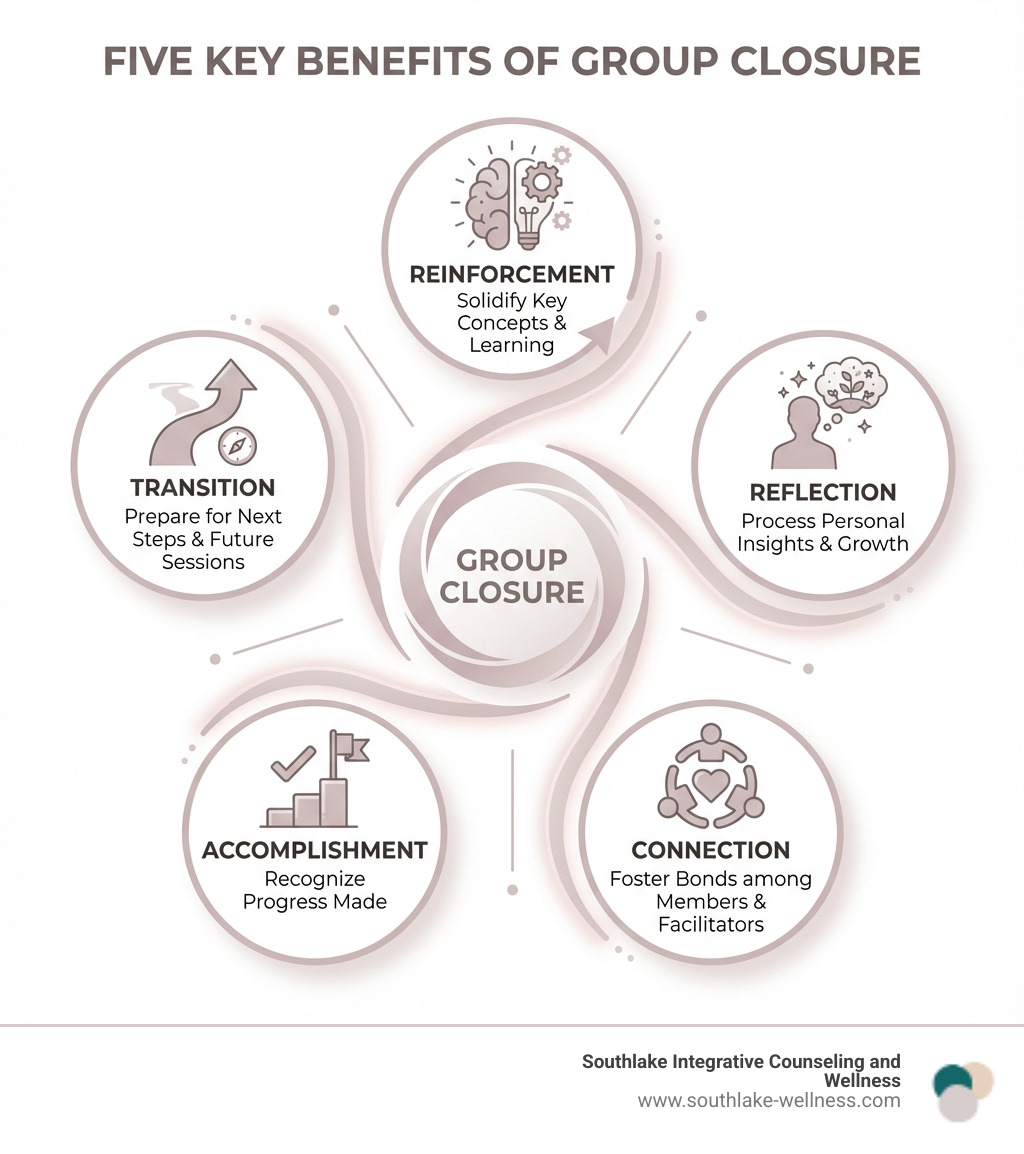
At Southlake Integrative Counseling and Wellness, we understand that a well-structured ending is not merely a formality; it's a cornerstone of effective group work. The purpose of structured closure in any group setting—be it a therapy session, a corporate workshop, or an educational class—is multi-faceted. It ensures that participants feel acknowledged, that their contributions are valued, and that they leave with a clear sense of what they've gained. Without proper closure, a session can feel incomplete, leaving participants with lingering questions or an unaddressed sense of unease.
The research consistently shows that closure activities offer multiple benefits, adding extra impact and meaning to a lesson or session. They help participants process their thoughts and feelings, check their perceptions against those of other group members, and prepare for future sessions or the application of new skills in their daily lives. This process is particularly vital in therapeutic settings, where emotional processing and validation are paramount.
Key Components of Effective Closure
So, what makes a group closure truly effective? We've identified several key components that, when woven together, create a powerful and positive ending:
- Summarizing Key Points: A good closure begins with a concise review of the main themes, discussions, and insights shared during the session. This reinforces learning and ensures everyone is on the same page.
- Inviting Reflection and Sharing: Participants need a dedicated space to articulate their thoughts, feelings, and personal takeaways. This could be a verbal share-out, a written exercise, or a creative expression. It helps them internalize the experience.
- Reinforcing Progress and Accomplishments: Acknowledging the growth, contributions, and achievements of individual members and the group as a whole fosters a profound sense of accomplishment. This positive reinforcement is crucial for self-esteem and motivation.
- Addressing Questions and Concerns: Providing an opportunity for participants to ask lingering questions or voice concerns clears up misunderstandings and ensures they don't leave feeling confused or deflated.
- Building Anticipation and Bridging to the Future: An effective closure doesn't just end; it transitions. It might link to new ideas, set goals for the next session, or encourage the application of learned skills in daily life. This forward-looking element fuels motivation and commitment.
Fostering a Sense of Accomplishment
An optimistic closure is designed to leave participants with a positive tone and a lasting impression. It's about celebrating the journey and the progress made, no matter how small. When individuals feel their efforts and insights have been recognized, it boosts their confidence and self-efficacy. For example, in our group therapy sessions in Southlake, Texas, we often see participants gain immense strength from acknowledging their courage to share, their willingness to listen, and their newfound coping skills. This sense of accomplishment is a powerful motivator for continued growth.
Building Anticipation for Future Sessions
Beyond wrapping things up, effective closure activities also serve as a bridge to what's next. By creating a link to new ideas or outlining potential next steps, we can build anticipation for future sessions or the continued application of learned strategies. This prepares participants mentally and emotionally, fostering a sense of continuity and purpose.
The Role of Reflection in Learning
Reflection is the bedrock of deep learning and personal growth. Closure activities emphasize reflection and symbolic closure, allowing participants to consolidate and internalize key information. It's an opportunity to connect new insights to existing knowledge and consider how these learnings can be transferred to new situations. Whether through journaling, discussion, or creative exercises, reflection helps individuals make sense of their experiences and solidify their skills.
Benefits of Optimistic Closures
An optimistic closure is a powerful tool for well-being. It creates a sense of accomplishment, encourages anticipation for future learning, and ensures that participants leave with a positive outlook. A positive ending can mitigate any challenges encountered during the session, leaving a pleasant "recency effect" that colors the entire experience. It's about ensuring that no one leaves feeling confused or deflated, but rather uplifted and equipped.
Fostering Community and Connection
"Closing ceremonies bring people closer together," the research reminds us. Just like a Morning Meeting, a closing circle can give group members a sense of calm, safety, and community. These rituals increase feelings of belonging, significance, and fun. In our diverse groups at Southlake Integrative Counseling and Wellness, fostering this sense of connection is paramount. It reinforces that participants are part of something bigger, a supportive network where they are seen and heard.
Addressing Participant Concerns
One of the vital functions of closure is to provide a safe space for participants to express any lingering concerns or questions. This can be facilitated through open discussion, anonymous feedback, or structured check-ins. By actively inviting and addressing these concerns, we ensure that everyone's voice is heard and that misunderstandings are clarified before the session ends. This attention to individual needs is crucial for trust and continued engagement. For more insights on developing personal resilience, explore our guide on building emotional resilience.
20+ Creative Closure Activities for Groups
Now that we understand the "why," let's dive into the "how." Here are some of our favorite creative and engaging closure activities for groups, categorized for your convenience.
Quick & Simple Closure Activities (Under 5 Minutes)
Sometimes, time is of the essence, but that doesn't mean you should skip closure! These activities are perfect for when you need a meaningful wrap-up in a flash.
- One-Word Whip: Go around the circle (or virtual room) and ask each person to share one word that encapsulates their biggest takeaway, feeling, or learning from the session. It's quick, low-pressure, and provides a snapshot of the group's overall experience.
- 3-2-1 Feedback: Participants quickly jot down or verbally share: 3 things they learned, 2 questions they still have, and 1 feeling they are taking away from the session. This structured approach helps consolidate learning and flags any remaining uncertainties.
- Thumbs Up/Down/Sideways: Ask a specific question about understanding or agreement (e.g., "How confident do you feel about applying this new skill?"). Participants respond by holding their thumb up (confident), down (not confident), or sideways (somewhat confident). You can invite a few people to briefly explain their choice.
- Exit Tickets: A classic for a reason! Before leaving, each person writes down a key learning, a question, or a commitment on a small card or slip of paper. These are collected at the door, providing valuable anonymous feedback. This allows individuals to reflect on their learning and you to gauge comprehension.
- Quick Rating (Fist-to-Five): Ask participants to hold up a number of fingers (0 to 5) to rate their understanding, engagement, or readiness to apply a concept. For example, 5 fingers means "totally got it!" and 0 means "totally lost." It’s a fast, visual way to check the group's pulse.
Reflective & Summarizing Closure Activities for Groups

- Snowball Fight: This is a fun and energetic way to share takeaways. Have everyone write one key learning or moment of insight on a piece of paper. When prompted, crumple the papers into "snowballs" and gently toss them around the room for about 30 seconds. Then, everyone picks up a new snowball, opens it, and reads the learning aloud. This "fosters reflection and reinforcing learning in a fun way."
- Gallery Walk: Divide participants into small groups and have them create a visual summary of their key learnings on large paper or a digital whiteboard. Once complete, they "gallery walk" around the room (or view shared screens), leaving sticky notes with questions or comments on other groups' work. This promotes peer learning and reinforces content.
- Two-Dollar Summary: Challenge participants to summarize the session's main points in exactly 20 words (metaphorically, each word costs 10 cents to make a two-dollar summary). This forces conciseness and critical thinking about what's most important.
- Journal Entry: Provide a few reflective prompts (see list below) and give participants 5-10 minutes to write in a journal. This allows for private, deeper processing of emotions and ideas without the pressure of sharing aloud.
- Postcard to a Future Self: Participants write a postcard addressed to themselves (or an imaginary friend) a few weeks or months in the future. On the postcard, they describe what they learned, how they felt, and one thing they commit to doing differently. This connects learning to future action.
- The "So What" Question (Long-Term Relevance): Ask participants to consider the long-term impact of what they've learned. "What from this session will still matter to you in one year? In five years?" This helps individuals connect the session's content to their broader life goals and values.
For deeper reflection, we encourage using question stems framed around Bloom’s Taxonomy. Here are some reflective question prompts you can adapt:
- What was your biggest breakthrough moment or insight today?
- What is one specific skill or piece of knowledge you gained that you will try to apply this week?
- What question do you still have, or what topic would you like to explore further?
- How did you contribute to the group's learning or support others today?
- What feeling are you taking away from this session, and why?
- If you had to teach one concept from today's session to a friend, what would it be and how would you explain it?
Interactive & Kinesthetic Closure Activities
Getting people up and moving can be a great way to re-energize the group and facilitate learning integration, especially after a long session.
- High-Five Hustle: Ask everyone to stand up and find a partner for a quick high-five. Then, pose a question related to the session (e.g., "Share one thing you're grateful for about this group"). After a minute, play some upbeat music (like "Do the Hustle"!) and have them find a new partner and repeat with a different question. This activity is energetic and promotes peer discussion. You can see the High-Five Hustle in action for inspiration!
- Ball Toss Takeaway: Have the group stand in a circle. Toss a soft ball to someone, and the person who catches it shares one key takeaway or feeling from the session. They then toss the ball to someone else. This keeps energy high and ensures everyone has a chance to participate.
- Human Knot Debrief: If appropriate for your group's dynamic, this team-building exercise can be adapted for debriefing. Participants stand in a circle, reach across, and grab two different hands from people opposite them, forming a "knot." The challenge is to untangle without letting go. Afterward, debrief not just on the problem-solving, but on lessons learned about communication, patience, and collaboration within the group.
- Four Corners: Label four corners of the room (or assign four options for virtual participants to select via poll/chat) with different responses to a statement (e.g., "Strongly Agree," "Agree," "Disagree," "Strongly Disagree" to "I feel confident in my ability to manage stress"). Participants move to the corner that best represents their feeling and briefly discuss why.
- Teach a Tot: This lighthearted activity challenges participants to explain a complex concept from the session in terms simple enough for a toddler (or first-grader) to understand. This forces simplification and checks for true comprehension. It's a fun way to reinforce understanding without making it feel like a test.
For even more ideas to boost engagement and well-being, explore our fun mental health group activities.
Facilitating and Adapting Your Group Closure
The success of any closure activities for groups hinges on thoughtful facilitation and a willingness to adapt.
Strategies for Effective Facilitation
- Summarizing Key Points: As the facilitator, it's our role to help consolidate the session's content. We summarize key points, connect discussions, and reiterate the main themes that emerged. This ensures clarity and helps reinforce learning.
- Reinforcing Learning: Beyond summarizing, we actively help participants internalize what they've learned. This might involve encouraging them to articulate how they'll apply new skills, or by providing a framework to connect new information with existing knowledge.
- Effective Time Management: We know that time can fly, especially in engaging group sessions. It's crucial to allocate adequate time for closure, typically around 10% of the session's total duration. For a 60-minute session, that's 6 minutes dedicated to wrapping up. Always have a few quick closure activities in your back pocket in case time runs short.
- Addressing Participant Questions: We create a safe and open space for individuals to voice concerns or ask questions. This means actively listening, validating their inquiries, and offering relevant resources or guidance. Our goal is that no one leaves feeling confused or with unresolved issues.
- Common Pitfalls to Avoid: We've all been there – rushing the closure, skipping it entirely, or making it a lecture rather than an interactive process. A common pitfall is misusing rigid models, like Madeline Hunter’s lesson plan model, as a mere checklist rather than understanding the spirit of each component. Avoid making closure about your performance; instead, make it about the group's experience and learning. Always follow up on questions or concerns that couldn't be fully addressed in the moment. For deeper insights into managing group dynamics, check out our tips for facilitating group counseling sessions.
Adapting closure activities for groups in virtual settings
In our increasingly connected world, many of our groups meet virtually. Adapting closure activities for groups in a virtual setting requires a bit of creativity but is entirely achievable.

- Using the Chat for One-Word Whip: The chat function is your best friend in virtual settings. Participants can quickly type their one-word takeaway, creating a scrollable stream of insights.
- Digital Whiteboards for Gallery Walks: Tools like Miro, Jamboard, or Mural are perfect for virtual Gallery Walks. Groups can collaborate in breakout rooms to create their visual summaries, then share their screens or link to their boards for a collective review.
- Polls for Quick Ratings: Most virtual platforms offer polling features. Use them for quick ratings (e.g., "On a scale of 1-5, how confident are you?") or for Four Corners-style activities.
- Breakout Rooms for Small Group Discussions: Assigning smaller groups to breakout rooms for reflective discussions (like the High-Five Hustle or Teach a Tot, adapted for virtual sharing) allows for more intimate sharing before returning to the main room for a brief summary.
- Screen Sharing for Presentations: Participants can use screen sharing to present digital summaries, mind maps, or even a "movie poster" of their learning, much like a traditional Gallery Walk.
We frequently use these strategies in our virtual mental health groups and workshops, and they are highly effective. You can find more ideas for virtual mental health workshops on our site.
Using Closure as an Assessment Tool
Closure activities for groups are not just for reflection and connection; they are also powerful assessment tools. As facilitators, we can gain invaluable insights into the group's learning and comprehension, which then informs our planning for future sessions.
- Exit Tickets for Comprehension: Reviewing exit tickets provides direct feedback on what participants learned, what confused them, and what questions remain. Categorizing these into "Got It," "More Practice, Please," or "I Need Some Help!" (as suggested by the research) can quickly highlight areas for follow-up.
- Observing Discussions for Understanding: During verbal closure activities like the One-Word Whip or 3-2-1 Feedback, listen attentively to the language participants use. Do they accurately articulate concepts? Are there common misconceptions? This informal assessment is a critical indicator of learning.
- Reviewing Written Summaries: Activities like the Two-Dollar Summary or Journal Entries offer tangible evidence of how well individuals have processed and synthesized the session's content.
- Gauging Group Energy and Mood: Pay attention to the overall emotional tone during closure. An optimistic, engaged group suggests successful learning and positive emotional processing. A quiet or disengaged group might indicate confusion, unresolved issues, or simply exhaustion. This qualitative assessment helps us understand the group's emotional state.
- Informing Future Session Plans: The insights gained from closure activities are vital for adapting and refining future sessions. If many participants are confused about a concept, we know to revisit it. If a particular activity resonated well, we might incorporate more like it. This continuous feedback loop ensures our group work remains responsive and effective. Our commitment to evidence-based practices means we constantly evaluate and refine our approaches, including how we close sessions. Learn more about our evidence-based group therapy approaches.
Frequently Asked Questions about Closure Activities
We often get questions about how to best implement closure activities for groups. Here are some of the most common ones we hear:
How do you end a group therapy session effectively?
Ending a group therapy session effectively is an art form that blends structure with empathy. Here's our approach at Southlake Integrative Counseling and Wellness:
- Summarize Key Themes: We always begin by briefly recapping the major themes, insights, and discussions that emerged during the session. This helps to consolidate the experience for everyone.
- Invite Final Reflections: We create a safe space for each participant to offer a final thought, feeling, or takeaway. This might be a one-word share, a sentence completion, or a brief personal reflection. It allows for individual processing and validation.
- Reinforce Progress and Coping Skills: We highlight the strengths demonstrated and the coping skills discussed or practiced. Acknowledging individual and group progress reinforces positive behaviors and builds confidence.
- Acknowledge Each Member's Contribution: Even in a short wrap-up, a quick glance and a nod, or a brief verbal acknowledgement, can make each person feel seen and valued for their presence and vulnerability.
- Bridge to the Next Session or Post-Group Life: We conclude by gently transitioning. This could involve assigning a brief "homework" exercise, reminding them of the next session's topic, or simply encouraging them to carry their insights into their week.
For a comprehensive guide, refer to our article on closing a group counseling session.
What makes a closure activity successful?
A successful closure activity, whether in a therapeutic, educational, or professional setting, possesses several key characteristics:
- Relevance to the Session's Content: It directly ties into what was discussed, learned, or experienced during the session, reinforcing its purpose.
- High Participant Engagement: It's interactive, inviting active participation rather than passive listening. This makes it memorable and impactful.
- A Positive and Supportive Tone: It fosters an optimistic and encouraging environment, leaving participants feeling uplifted, acknowledged, and motivated.
- Provides a Genuine Opportunity for Reflection: It encourages individuals to process their thoughts and feelings, integrating new insights into their personal framework.
- Creates a Clear Sense of Completion: Participants leave feeling that the session has reached a natural and satisfying conclusion, with no lingering loose ends or confusion.
How can you do a quick closure when time is short?
We've all faced the clock crunch! When time is limited, we rely on these efficient yet impactful closure strategies:
- One-Word Whip: This is probably the fastest. Go around the room and ask everyone for one word to describe their current feeling or biggest takeaway. It takes mere seconds per person.
- Ask for a Single Key Takeaway: Simply ask each person to share one thing they will remember or apply from the session. It's concise and focuses on immediate application.
- Use a Fist-to-Five Rating to Gauge Understanding: A quick visual check of where everyone stands on a particular concept. It's non-verbal and very fast.
- Pose One Powerful Reflective Question for Participants to Ponder on Their Way Out: Instead of a group share, offer a thought-provoking question (e.g., "What is one thing you're taking with you today?") and tell them to reflect on it as they leave. This carries the learning beyond the room.
Conclusion
The power of closure activities for groups cannot be overstated. They are not merely an administrative necessity but a crucial component of effective group facilitation, whether in therapy, workshops, or educational settings. By dedicating time to a structured, reflective, and optimistic wrap-up, we ensure that participants consolidate their learning, feel a profound sense of accomplishment, and strengthen their connections with one another. This intentional ending creates a lasting impression, leveraging the recency effect to improve memory and reinforce the value of the experience.
At Southlake Integrative Counseling and Wellness, we believe that holistic wellness encompasses every part of the journey, including how we bring experiences to a close. Our commitment is to foster connection and growth, ensuring that every individual who engages with our groups leaves feeling supported, understood, and equipped for their path forward. We carefully design our group experiences, recognizing that a strong finish is vital for integrating insights and inspiring continued well-being.
To learn more about our structured, supportive group experiences and how they can benefit you, we invite you to explore our group therapy and wellness services in Southlake, Texas.