
Why Learning to Practice Mindfulness Matters Now
Learning how to practice mindfulness is simpler than you might think. It's a way to step off the autopilot of daily life and wake up to the present moment.
Quick Guide to Practicing Mindfulness:
- Find a comfortable spot and sit for 5-10 minutes.
- Focus on your breath as it moves in and out.
- Notice when your mind wanders (this is normal).
- Gently bring your attention back to your breath without judgment.
- Repeat daily for the best results.
Mindfulness is the practice of paying attention to the present moment without judgment. It’s not about stopping your thoughts, but about observing what's happening right now—in your body, mind, and surroundings.
Research shows that mindfulness can be as effective as medication for easing anxiety and also helps with depression, chronic pain, and stress. Benefits include better sleep, sharper focus, and healthier blood pressure. The National Institute for Health and Care Excellence even recommends mindfulness-based therapies for depression and workplace wellbeing.
The best part? You already have everything you need. No special equipment or apps are required. Simple exercises can be done anywhere, while formal practices just need a quiet space.
As Holly Gedwed, a Licensed Professional Counselor Associate with 14 years of clinical experience, I've seen how learning how to practice mindfulness helps clients break unhealthy patterns and build coping skills for stress, anxiety, and trauma, guiding them toward lasting emotional balance.
Understanding the Core of Mindfulness
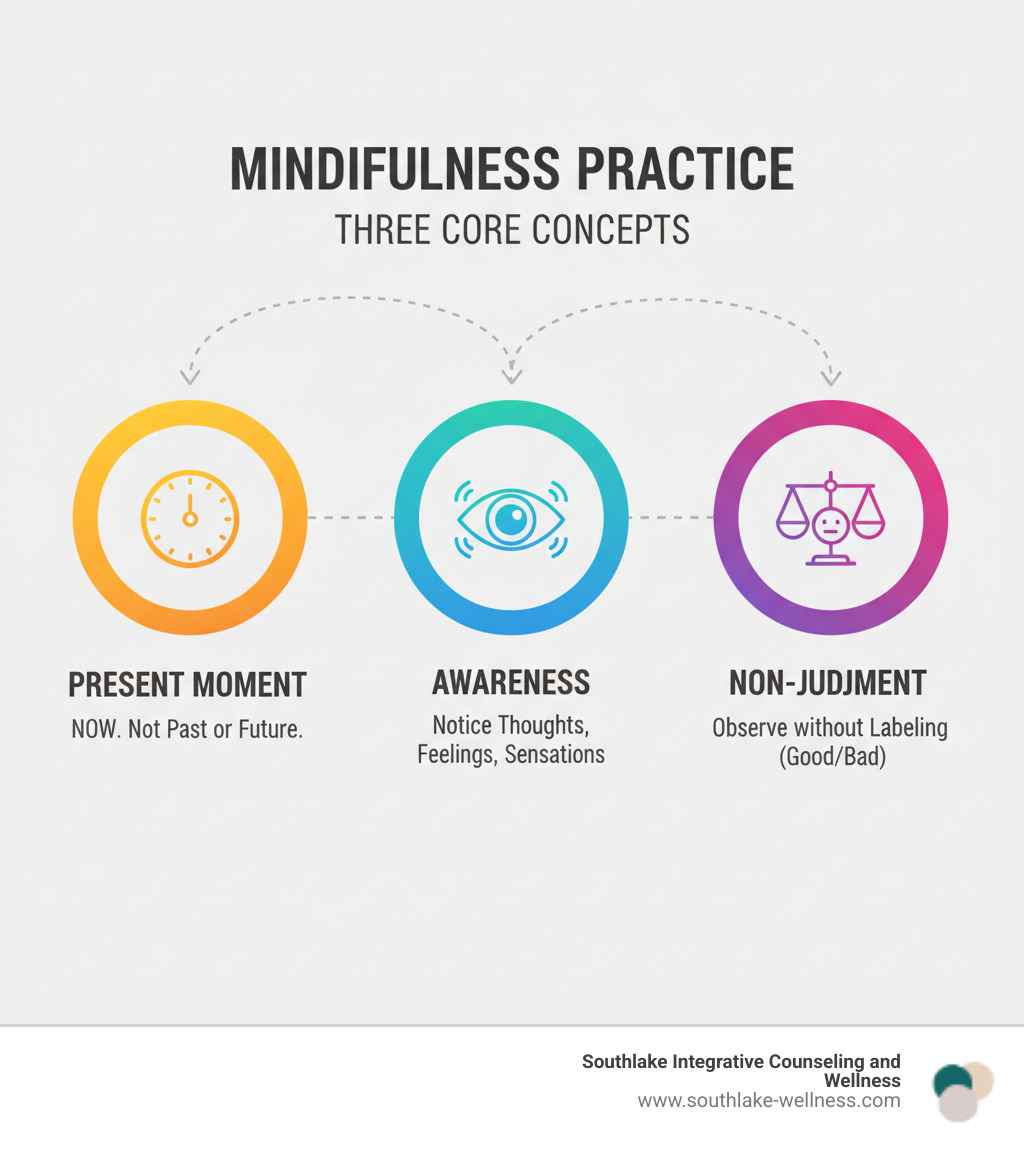
At its heart, mindfulness is about being present—noticing what’s happening within and around you, moment by moment, without judgment. It is often defined as focusing on what you're sensing and feeling "without interpretation or judgment." It's a natural human ability that often gets buried under the rush of daily life.
When learning how to practice mindfulness, three core principles guide the practice:
- Attention: Deliberately focusing your awareness on the present moment, such as your breath or a sound.
- Intention: Actively choosing to bring your full awareness to whatever you're doing right now.
- Attitude: Approaching your experience with acceptance (letting things be), curiosity (staying open), and a beginner's mind (seeing each moment as new).
This attitude includes non-judgment—observing thoughts and feelings without labeling them as good or bad. Thoughts are just mental events, not necessarily truths.
PracticePrimary FocusGoalMindfulnessPresent moment awareness without judgmentCultivating a state of being fully present, aware, and non-reactive in daily lifeMeditationFormal practice (e.g., sitting, walking, body scan) to train attentionDeveloping sustained mindfulness, mental clarity, emotional regulation, and self-awarenessSelf-CompassionTreating oneself with kindness, understanding, and acceptance during sufferingReducing self-criticism, fostering emotional resilience, and responding to pain with warmth
At Southlake Integrative Counseling and Wellness, we integrate these elements into our treatment. Learn more info about our Holistic Approach Therapy.
What is Mindfulness vs. Meditation?
People often use these terms interchangeably, but they're different.
Mindfulness is a quality of awareness—a state of being present that you can bring to any moment, like eating breakfast or listening to a friend.
Meditation is the formal practice used to cultivate mindfulness. It's the exercise that strengthens your mindfulness muscle. Think of it this way: fitness is a quality, while going to the gym is the practice that builds it.
During meditation, you focus on an anchor like your breath. The goal isn't to stop your thoughts, which is a common misconception. The practice is noticing when your mind has wandered and gently bringing your attention back to your anchor without self-criticism. That gentle returning, over and over, is the real work.
The Role of Self-Compassion and Non-Judgment
When learning how to practice mindfulness, many people encounter their inner critic. This is where self-compassion is essential. When your mind wanders, treat yourself as you would a good friend.
A wandering mind is normal, not a sign of failure. It's an opportunity to practice. Each time you notice your mind has strayed and gently bring it back, you're doing it correctly.
Self-compassion means treating yourself with kindness when things are difficult. As researcher Kristin Neff notes, it's about being warm and understanding toward yourself when you suffer, rather than ignoring your pain or beating yourself up.
When difficult emotions arise, avoid self-criticism. Notice the emotion, acknowledge it without judgment, and return your attention to your breath. This compassionate, non-judgmental attitude makes the practice more effective and builds emotional resilience that carries into all areas of life. It's a powerful way to develop coping skills for life's challenges.
The Science-Backed Benefits of a Mindful Life
Ancient wisdom is now enthusiastically accepted by modern science. Decades of research show that learning how to practice mindfulness is a powerful way to transform our mental and physical well-being.
One of the most celebrated benefits is stress reduction and anxiety management. Studies consistently show that mindfulness can significantly ease feelings of stress, anxiety, and even depression, with some research indicating it can be "as effective as medication in easing anxiety."

The positive effects of a mindful life extend even further:
- Eases depression symptoms: The National Institute for Health and Care Excellence (NICE) recommends mindfulness-based therapies for less severe depression. See the Research on mindfulness for depression.
- Improved focus and attention: Mindfulness trains your brain to concentrate better, leading to "sharper focus and fewer distractions."
- Better sleep quality: By calming mental chatter, mindfulness helps improve overall rest.
- Lower blood pressure: Regular practice contributes to a healthier heart.
- Pain management: It helps change our relationship with pain, teaching us to respond to sensations differently.
- Boosted immune function: Consistent practice has been linked to "fewer sick days."
- Keeps the mind sharp: Mindfulness can "potentially fend off cognitive decline," promoting long-term brain health.
- Increased productivity and emotional balance: By reducing worry and rumination, mindfulness can "decrease job burnout" and "improve mood."
At Southlake Integrative Counseling and Wellness, we see these benefits changing lives. Integrating mindfulness empowers our clients to develop powerful Holistic Stress Management Techniques for a more balanced and resilient life.
How to Practice Mindfulness: Simple Exercises for Beginners
Starting your mindfulness journey is accessible—you can begin right where you are. When first learning how to practice mindfulness, consistency matters more than duration. Even five minutes a day can be helpful. We recommend starting with 5-10 minute sessions and building up gradually.
For structured exercises, find a quiet space without distractions. However, many simple mindfulness exercises can be woven into your daily routine.

Informal Mindfulness in Everyday Activities
Mindfulness can transform ordinary moments into opportunities for peace.
- Mindful eating: When you eat, take time to smell, taste, and truly enjoy your food. Notice the textures, temperature, and flavors.
- Mindful walking: As you walk, pay attention to the sensation of your feet on the ground, the rhythm of your steps, and the air on your skin.
- The 5-4-3-2-1 grounding technique: To return to the present, identify five things you can see, four you can touch, three you can hear, two you can smell, and one you can taste.
- Single-tasking: Research shows multitasking actually hurts productivity. Try giving one task your full, undivided attention.
- Mindful listening: When someone speaks, put away distractions and focus on their words, tone, and body language without planning your response.
Formal Meditations: A Guide on How to Practice Mindfulness
Formal meditation sessions are where we strengthen our mindfulness muscle.
- Sitting meditation with a breath anchor: Sit comfortably and bring your attention to your breath. Notice the sensation of air moving in and out. When your mind wanders, gently guide your attention back to your breath. This returning is the practice.
- Body scan meditation: Lie down or sit comfortably. Slowly move your awareness through your body from your toes to your head, noticing any sensations without judgment.
- Walking meditation: Walk slowly and deliberately, focusing on the physical sensations of walking—the lift of your foot, the contact with the ground, the shift of your weight.
- Mindful movement and Yoga: Gentle yoga, tai-chi, or simple stretching helps you reconnect with your body and breath in motion.
- Progressive muscle relaxation: Systematically tense and then relax different muscle groups to recognize and release physical tension.
Guided meditations can be helpful for beginners. A 15-minute guided meditation can be a calming ritual to end your day. The key is finding what resonates with you and making it a regular part of your life.
Weaving Mindfulness into Your Daily Routine
Making mindfulness a consistent part of your life is where the real magic happens. It’s about carrying awareness from the meditation cushion into your day.
When considering how to practice mindfulness, consistency trumps duration. Start with 5-10 minutes a day. "Daily practice works best," but aiming for three or four times a week is a great start. As it becomes a habit, mindfulness feels more "effortless."
Mindfulness at Work
Workplaces can be stressful, but integrating mindfulness can help. The National Institute for Health and Care Excellence (NICE) even "recommends that employers make mindfulness available to all employees."
Here's how to bring calm awareness to your workday:
- Mindful Breaks: Step away from your screen for a few minutes. Take some deep breaths and simply notice your surroundings.
- Focused Breathing at Your Desk: When stress arises, take a moment to focus on 3-5 deep, slow breaths to reset your nervous system.
- Single-Tasking: Instead of multitasking, which "research shows it actually hurts productivity," give one task your full attention. You'll likely be more focused and effective.
- Cultivate Gratitude: Notice positive things, like a kind word from a colleague or the successful completion of a task.
Regular practice builds resilience and provides tools for Burnout Stress Recovery.
Overcoming Common Challenges and Misconceptions
It's normal to encounter a few challenges when learning how to practice mindfulness.
- Myth: "I need to empty my mind." The goal is not to stop thoughts, but to observe them without judgment. There's no way to completely quiet your mind, and that's not the goal of the practice.
- Myth: "It's a religious practice." While it has roots in contemplative traditions, mindfulness is practiced today as a secular technique for well-being, accessible to all.
- Challenge: A wandering mind. Your mind will wander. This isn't failure; it's the opportunity to practice. Each time you notice your mind has drifted and gently bring it back, you are strengthening your attention muscle—a "bicep curl for your brain." This gentle returning is the core of the practice.
- Challenge: Dealing with difficult emotions. If uncomfortable emotions arise and feel overwhelming, it's okay to pull back. Focus on grounding sensations. For those with a history of severe trauma, it's important to approach mindfulness with "guidance from trained professionals."
- Challenge: Finding time. "I'm too busy" is a common hurdle. Even a few minutes a day can make a big difference. Consistency is more impactful than sporadic long sessions and helps you Build Emotional Resilience.
Frequently Asked Questions about Practicing Mindfulness
As people in Southlake, TX, begin their mindfulness journey, some common questions arise.
How long does it take to feel the benefits of mindfulness?
Some benefits, like a sense of calm, can be immediate. After a single 5-minute session, you might feel clearer and more relaxed.
For deeper, lasting changes—like improved stress management, focus, or sleep—consistency is key. Research suggests that with daily practice over several months, mindfulness can become effortless. Studies show that even 12 minutes of meditation, 5 days a week, can strengthen your ability to pay attention. Think of it like exercise: you feel good after one session, but real change happens when you keep showing up.
Is there a 'right' or 'wrong' way to meditate?
No, there isn't a wrong way. This is one of the most liberating aspects of learning how to practice mindfulness.
Many people think they're failing when their mind wanders. But a wandering mind isn't a problem—it's the point. The practice is getting lost in thought, noticing it, and gently returning your focus to your breath or another anchor. If you're doing that, you're doing it right. It's about progress, not perfection.
Can mindfulness be unhelpful or make things worse?
This is an important question. For most people, mindfulness is highly beneficial. However, it's not right for everyone.
For individuals with a history of severe trauma or certain mental health conditions (like severe PTSD or psychosis), turning inward can sometimes be overwhelming. If difficult emotions or memories surface too intensely, the practice can feel worse rather than better.
If this applies to you, it's crucial to speak to your health care team before trying these exercises. If you become very uncomfortable during practice, please reach out for professional support.
At Southlake Integrative Counseling and Wellness, we offer services like Anxiety Therapy Southlake to help you explore mindfulness in a safe, supportive therapeutic context, ensuring it's integrated appropriately into your treatment plan.
Deepen Your Practice and Accept Well-Being
Learning how to practice mindfulness is a lifelong journey of waking up to the life you're already living.
The key takeaway is that mindfulness is accessible to everyone. You don't need special equipment or hours of free time—just a willingness to pay attention without judgment and to treat yourself with kindness when your mind wanders. Whether it's a formal meditation or simply pausing to notice your breath, you are cultivating a skill that can transform your relationship with stress.
Start with just five minutes a day. Be patient. You might find these moments of presence naturally expand into your daily life, turning chores into opportunities for awareness.
At Southlake Integrative Counseling and Wellness, we've seen the power of mindfulness in our clients' healing journeys. We integrate mindfulness into our holistic treatment plans because it creates a foundation for lasting change, bridging the gap between mind and body, struggle and acceptance. This synergistic approach honors both your inner wisdom and the support of professional guidance.
If you're in Southlake, Texas, and feel called to deepen your practice in a supportive environment, we invite you to Learn more about our Mindfulness-Based Group Therapy.
Every moment is a fresh start. You simply need to begin, and then begin again, with compassion and curiosity. Your well-being is worth this investment of mindful attention.