
Why Finding the Right Integrative Therapist Matters for Your Well-Being
Finding an integrative therapist near me can feel overwhelming, but it's a crucial step toward holistic healing. Here's what you need to know:
Quick Guide to Finding an Integrative Therapist:
- Search online directories - Look for therapists with credentials like LPC, LMFT, or PsyD who list integrative or holistic approaches
- Check their specialties - Ensure they address your specific needs (anxiety, trauma, chronic pain, etc.)
- Review their modalities - Look for a blend of evidence-based therapies (CBT, EMDR) with complementary approaches (mindfulness, somatic work)
- Schedule a free consultation - Most integrative therapists offer 15-minute calls to assess fit
- Verify insurance coverage - Contact your provider to confirm coverage for mental health services
Traditional talk therapy doesn't work for everyone. Maybe you've spent months discussing your problems without feeling real change. Or perhaps you know your anxiety lives in your body, not just your mind.
That's where integrative therapy comes in.
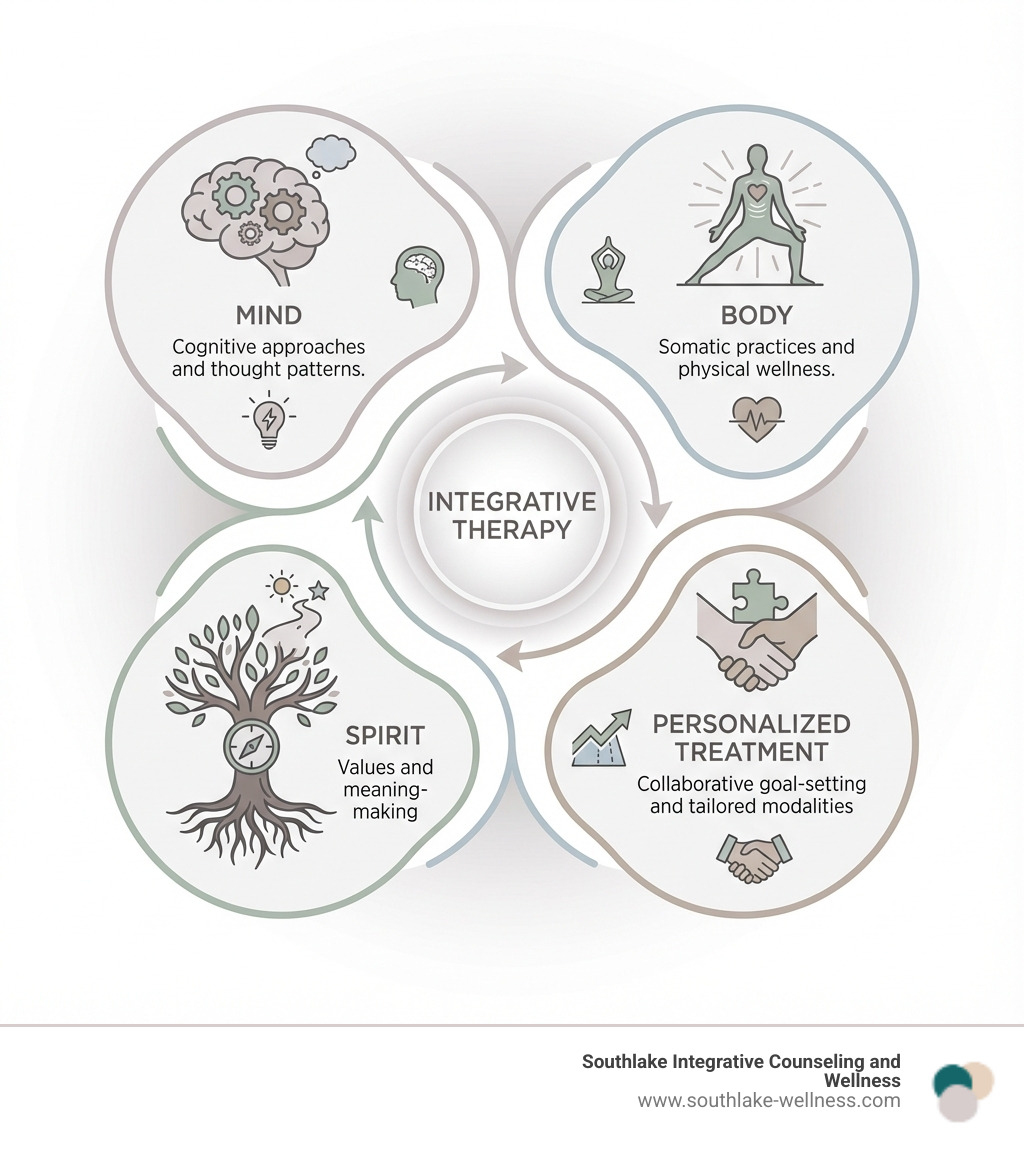
Unlike conventional approaches that focus solely on thoughts and emotions, integrative therapy treats the whole person—mind, body, and spirit. It blends evidence-based techniques like Cognitive Behavioral Therapy with complementary practices such as mindfulness, somatic work, and expressive arts.
The demand for this approach is growing fast. Holistic and somatic psychotherapy has seen a 30% increase in the last three years, as more people recognize that healing requires more than just talking. Research shows that integrated treatment models are 20% more effective for complex mental health conditions compared to single-modality approaches.
What makes integrative therapy different is its personalized nature. Your therapist works with you to create a treatment plan custom to your unique needs, history, and goals. Whether you're dealing with chronic stress, unresolved trauma, relationship struggles, or life transitions, this collaborative approach helps you build lasting resilience and emotional balance.
I'm Holly Gedwed, a Licensed Professional Counselor Associate with 14 years of clinical experience specializing in trauma and addiction. When clients ask me how to find an integrative therapist near me, I guide them through selecting practitioners who customize therapeutic approaches—including CBT, DBT, Acceptance & Commitment Therapy, and Narrative Therapy—to match each person's unique needs and goals.
What is Integrative Therapy? A Holistic Path to Wellness
So, you're curious about integrative therapy. Excellent choice! It's a truly refreshing approach to mental health that moves beyond the traditional one-size-fits-all model. At its core, integrative therapy is about blending various therapeutic modalities and techniques to create a treatment plan that is uniquely suited to you. Think of it like a master chef selecting the perfect ingredients from a diverse pantry to create a dish that tantalizes your specific palate – only here, the dish is your well-being.
How does this differ from traditional therapy? Well, traditional therapy often adheres to a single theoretical framework, like Cognitive Behavioral Therapy (CBT) or psychodynamic therapy. While these approaches are incredibly valuable and effective for many, they might not fully address every aspect of an individual's experience. We understand that you are a complex being, influenced by your thoughts, feelings, physical sensations, social environment, and spiritual beliefs.
Integrative therapy, on the other hand, accepts this complexity. It acknowledges that healing isn't always linear and that different tools might be needed for different parts of your journey. We carefully select and combine evidence-based therapies with complementary approaches, creating a dynamic and flexible treatment custom just for you. This means we might use CBT to address thought patterns, EMDR to process trauma, somatic therapy to release tension stored in the body, mindfulness to cultivate present-moment awareness, or even expressive arts therapy to help you communicate feelings that words can't quite capture.
This blending isn't just about throwing everything at the wall to see what sticks. It's a thoughtful, informed process guided by clinical expertise and your individual needs. The goal is to treat the whole person – mind, body, and spirit – rather than just focusing on symptoms. This holistic perspective is why integrated treatment models have been shown to be 20% more effective in treating complex mental health conditions compared to traditional single-modality therapies. It’s like getting a personalized roadmap for your healing journey, rather than a generic one.
To dive deeper into how this powerful approach can work for you, explore our comprehensive guide: Integrative Therapy Guide. You can also learn More on our holistic approach.
The Transformative Benefits of an Integrative Approach

Imagine a therapy experience where you're not just a passive recipient, but an active participant in your own healing. That's one of the most profound benefits of seeking an integrative therapist near me. Our approach is designed to empower you, offering a truly transformative path to wellness.
One of the cornerstones of integrative therapy is the creation of personalized treatment plans. We recognize that no two individuals are alike, and what works wonders for one person might not resonate with another. By drawing from a diverse toolkit of therapeutic techniques, we can craft a plan that aligns perfectly with your unique strengths, challenges, and goals. This isn't just about symptom management; it's about fostering deep, sustainable change.
A key focus for us is the mind-body connection. We often carry stress, trauma, and unresolved emotions in our bodies, leading to physical symptoms like tension, fatigue, or even chronic pain. Integrative therapy helps you tune into these bodily sensations, understand their messages, and release what no longer serves you. This holistic wellness perspective means we're not just talking about your problems; we're helping you experience healing on a deeper, more embodied level.
Client empowerment is central to our philosophy. We believe you are the expert on your own life. Our role is to provide guidance, support, and the right tools, but ultimately, you are in the driver's seat. This active collaboration fosters a sense of agency and self-efficacy, helping you develop the skills and confidence to steer life's challenges long after therapy concludes. It's incredibly rewarding to watch our clients find their inner resilience!
The results speak for themselves: 75% of individuals seeking therapy report experiencing significant improvements in their mental health within the first six months of treatment. With an integrative approach, we aim for these improvements to translate into long-term well-being. By addressing the root causes of distress and equipping you with a diverse set of coping strategies, we help you build resilience that stands the test of time. You'll learn to respond to stressors more effectively, cultivate greater emotional balance, and live a more authentic and fulfilling life.
Ready to explore the specific approaches we use? Learn about our approaches. For a deeper dive into how an integrative perspective can improve your overall well-being, take a look at our Integrative Mental Health Guide.
How to Find a Qualified Integrative Therapist Near Me

Finding the right integrative therapist near me in Southlake, TX, is a bit like finding the perfect pair of shoes – it needs to be a comfortable, supportive, and functional fit for you. With the increasing demand for mental health services, and online therapy seeing a 50% increase in demand over the past two years, accessibility is greater than ever. But how do you ensure you're connecting with a truly qualified professional? Here's our step-by-step guide:
- Use Online Directories: Reputable online therapist directories are excellent starting points. You can filter by location (Southlake, Texas!), insurance, and specialties. Look for therapists who specifically mention "integrative," "holistic," "mind-body," or a blend of modalities in their profiles. For instance, our own professional profiles highlight our integrative approach.
- Check Credentials and Licenses: Ensure the therapist holds appropriate licensure in Texas. Common credentials include:
- LPC (Licensed Professional Counselor): These professionals have a master's degree in counseling and extensive supervised clinical experience.
- LMFT (Licensed Marriage and Family Therapist): While often working with couples and families, many LMFTs also provide individual therapy and use integrative approaches.
- PsyD (Doctor of Psychology): Clinical psychologists hold doctoral degrees and are trained in assessment and therapy.
- Look for any specialized training they highlight, such as EMDR, somatic experiencing, or mindfulness-based therapies.
- Read Reviews and Testimonials: While not the sole factor, reviews can offer insights into a therapist's style, effectiveness, and client experience. Do previous clients speak about feeling understood, empowered, or seeing tangible progress?
- Take Advantage of Free Consultations: Many integrative therapists, including us, offer a brief, free initial consultation (often 15 minutes). This is a fantastic opportunity to:
- Assess Fit: Do you feel a sense of connection and comfort? Trust and rapport are paramount in therapy.
- Ask Questions: Inquire about their specific integrative approach, what modalities they use most often, and how they tailor treatment.
- Discuss Logistics: Clarify fees, availability, and whether they offer in-person sessions in Southlake or virtual sessions.
- Consider Online Therapy: The rise of online therapy has made finding a qualified integrative therapist near me even easier, especially if your definition of "near me" extends to anywhere in Texas. This significantly broadens your options while maintaining the same quality of care.
We believe that finding the right therapist is a personal journey, and we're here to support you in that search. For more detailed guidance on navigating the search for a therapist within our state, check out our resource on How to Find Best Therapist in Texas. You can also view an example of a professional profile to see what to look for.
Your First Session: What to Expect and How to Prepare
Stepping into your first therapy session, especially with an integrative therapist near me, can bring a mix of excitement and nerves. That's perfectly normal! We want to explain the process so you feel prepared and comfortable. Think of it as the beginning of a collaborative adventure, where you're the guide and we're your trusty co-pilot.
The initial consultation, whether it's a brief phone call or your first full session, has a few key goals. For us, it's about getting to know you, understanding what brings you to therapy, and starting to map out how we can best support you. For you, it's an opportunity to gauge comfort, ask questions, and decide if our approach feels like the right fit.
During your first full session, we'll typically conduct a comprehensive intake. This isn't just a formality; it's a crucial step in building your personalized treatment plan. We'll ask about your current concerns, your personal history, family background, past experiences with therapy, and what you hope to achieve. This is where the integrative approach truly shines, as we'll also dig into aspects of your life that might not be covered in traditional intake forms. We might ask about your sleep patterns, dietary habits, stress levels, physical health, and even your spiritual practices. This helps us understand the interconnectedness of your well-being and identify all the pieces of the puzzle.
The integrative therapy process is inherently collaborative. We don't just tell you what to do; we work with you. This means your role as the client is incredibly important. We encourage active participation and openness. This doesn't mean you have to share everything all at once, but rather that you're willing to explore, experiment, and engage in the process. Be honest about what resonates with you and what doesn't. Providing feedback is not only welcome but essential, as it helps us fine-tune our approach to your unique needs.
There's no right or wrong way to be a client. Just come as you are, with an open mind and a willingness to explore. If you're looking for more details on what individual therapy entails, our Individual Therapy Southlake Guide is a great resource. You can also learn more about our philosophy and team on our About Us page. We're truly excited to meet you!
Frequently Asked Questions about Integrative Therapy
We get a lot of great questions about integrative therapy, and we're always happy to provide clarity. Here are some of the most common inquiries we receive:
What specific conditions can an integrative therapist near me help with?
The beauty of integrative therapy is its adaptability. Because we draw from a wide array of techniques and philosophies, we can effectively address a broad spectrum of issues and conditions. If you're searching for an integrative therapist near me in Southlake, TX, know that we are equipped to support you through many challenges, including:
- Anxiety: From generalized anxiety disorder to panic attacks and social anxiety, we combine cognitive, somatic, and mindfulness techniques to help you regulate your nervous system and shift anxious thought patterns. Our Anxiety Psychologist Near Me guide offers more insights.
- Depression: We work to understand the multifaceted roots of depression, integrating approaches that foster emotional processing, behavioral activation, and meaning-making to uplift your spirit and restore vitality.
- Trauma and PTSD: EMDR, somatic experiencing, and other trauma-informed approaches are central to our work, helping you process distressing memories and release the physical and emotional residue of past experiences.
- Chronic Illness and Pain: The mind-body connection is particularly vital here. We help you cope with the emotional toll of chronic conditions, develop pain management strategies, and foster resilience through holistic practices.
- Relationship Issues: Whether with partners, family, or friends, we use systemic and attachment-based approaches to improve communication, resolve conflict, and foster healthier connections. If you're in the wider DFW area, our Counseling Fort Worth, TX page has more information on relationship support.
- Stress and Burnout: We equip you with practical tools to manage stress, set boundaries, and prevent burnout by addressing both external pressures and internal coping mechanisms.
- Life Transitions: Navigating major life changes – career shifts, relocation, divorce, grief, or parenting – can be overwhelming. We provide support and guidance to help you find clarity and build resilience during these pivotal moments.
Essentially, if an issue impacts your mental, emotional, or physical well-being, an integrative therapist can likely offer valuable support.
How is an integrative therapist near me different from a life coach?
This is a common and excellent question! While both therapists and life coaches can help you achieve personal growth and reach your goals, their training, scope of practice, and areas of focus are fundamentally different.
An integrative therapist near me in Southlake, TX, is a licensed mental health professional. This means we have completed extensive graduate-level education (master's or doctoral degrees), rigorous supervised clinical hours, and passed state board examinations to earn licenses like LPC or LMFT. Our training includes clinical diagnosis, psychopathology, ethical practice, and evidence-based treatment for mental health disorders. We are qualified to diagnose and treat conditions such as depression, anxiety, trauma, and personality disorders. Our work often digs into your past to understand how it influences your present, helping you heal core wounds and develop healthier coping mechanisms.
A life coach, on the other hand, typically focuses on future-oriented goal-setting and personal development. While many coaches are highly skilled and effective, they are not licensed mental health professionals and are not trained or legally permitted to diagnose or treat mental health conditions. Their approach is generally prescriptive, helping you identify and overcome obstacles to achieve specific goals in areas like career, relationships, or wellness. They rarely dig into deep psychological issues or past traumas.
Think of it this way: if you have a broken leg, you go to a doctor (therapist). If you want to improve your running technique once your leg is healed, you might hire a running coach. Both are valuable, but their roles and expertise are distinct. We, as integrative therapists, can help you heal underlying issues, and support you in moving forward towards your life goals.
Is integrative therapy covered by insurance?
The question of insurance coverage is always a practical one, and we understand its importance. The short answer is: it varies.
Generally, many insurance plans do cover mental health services, and integrative therapy, because it incorporates evidence-based modalities, is often included. However, the specifics depend entirely on your individual insurance plan and provider.
Here's what we recommend if you're looking for an integrative therapist near me and plan to use insurance:
- Contact Your Insurer Directly: Call the number on the back of your insurance card. Ask about your mental health benefits.
- Inquire about your deductible, co-pay, or co-insurance for outpatient mental health services.
- Ask if you need a referral from a primary care physician.
- Crucially, ask if services provided by an LPC, LMFT, or PsyD are covered.
- Find out if there's a limit to the number of sessions covered per year.
- In-Network vs. Out-of-Network: Some therapists are "in-network" with specific insurance companies, meaning they have a contract with that company to provide services at a pre-negotiated rate. Others are "out-of-network." If your chosen therapist is out-of-network, your plan might still offer "out-of-network benefits," meaning they'll reimburse you for a percentage of the cost after you've paid the therapist directly. Many plans in Texas, including those offered by major providers like Aetna, BCBS, Cigna, Humana, and Optum, often cover services with licensed professionals.
- Sliding Scale Fees and Low-Cost Options: If insurance coverage is a concern or you don't have it, don't despair! Many practices, including ours, offer sliding scale fees based on income or can connect you with low-cost options through practicum students. Always discuss your financial concerns openly with your prospective therapist – we are here to help you find a solution.
We encourage you to reach out to us at Contact Us so we can discuss your specific situation and help you steer the payment options available.
Conclusion: Take the Next Step on Your Healing Journey
Finding the right support for your mental and emotional well-being is one of the most important investments you can make in yourself. As we've explored, seeking an integrative therapist near me offers a personalized, holistic, and highly effective path to healing and growth. It’s an approach that honors your unique story, taps into your innate resilience, and equips you with tools for lasting change.
We believe that true well-being comes from nurturing your mind, body, and spirit in harmony. This integrative philosophy is at the heart of everything we do at Southlake Integrative Counseling and Wellness. We're dedicated to providing compassionate, evidence-based care that supports you in building emotional balance, resilience, and a life that feels authentic and fulfilling.
If you're ready to move beyond traditional therapy and start on a journey of deeper self-findy and healing, we invite you to take the next step. Don't let the search for an integrative therapist near me feel daunting. We're here to help you find the right fit and guide you through a process that respects every part of who you are.
Explore Our Integrative Therapy Services and find how our unique approach can support your long-term mental and emotional well-being. Your path to a more balanced and vibrant life begins now.