
Introduction to a More Mindful Way of Healing
Mindfulness based therapy is a powerful approach that combines ancient meditation practices with modern psychological techniques. It helps you manage depression, anxiety, and stress by changing how you relate to your thoughts and emotions.
Quick Answer: What You Need to Know
- What it is: A structured therapeutic approach that teaches you to observe thoughts without judgment, preventing negative spirals.
- How it works: Combines mindfulness meditation with cognitive therapy to interrupt automatic negative thinking patterns.
- Who it helps: People with recurrent depression, anxiety disorders, chronic stress, and related conditions.
- Proven results: Reduces depression relapse risk by nearly 50% and decreases symptoms by 30-60%.
- Format: Typically an 8-week group program with weekly sessions and daily home practice.
- Key difference: Focuses on changing your relationship with thoughts rather than changing the thoughts themselves.
When many feel trapped in cycles of negative thinking, mindfulness based therapy offers a way to fundamentally shift how you experience your own mind. It’s built on a profound truth: You are not your thoughts. When you're anxious or depressed, your mind can feel like an enemy. This therapy teaches you to step back from the mental noise and observe it without getting swept away.
Instead of trying to suppress or argue with negative thoughts (which often makes them stronger), you learn to notice them as temporary mental events—like clouds passing through the sky of your awareness. This subtle shift in perspective can be life-changing.
Research shows that mindfulness-based interventions are as effective as traditional cognitive-behavioral therapy. For people with recurrent depression, studies show mindfulness based therapy can be as effective as maintenance antidepressant medication in preventing relapse.
I'm Holly Gedwed, a Licensed Professional Counselor with 14 years of clinical experience. I've seen how mindfulness based therapy helps clients break free from destructive thought patterns and build lasting emotional resilience. In this guide, I'll walk you through everything you need to know about this transformative approach.
Understanding the Foundations of Mindfulness-Based Therapy
Mindfulness based therapy is built on a simple yet profound idea: while we can't always control what thoughts show up, we can change how we relate to them. This shift from fighting your thoughts to observing them with curiosity is where healing begins.
What is Mindfulness-Based Cognitive Therapy (MBCT)?
Mindfulness-Based Cognitive Therapy (MBCT) was developed in the 1990s by researchers Zindel Segal, Mark Williams, and John Teasdale. They wanted to understand why people who recover from depression often relapse. They finded that depression creates mental ruts—automatic patterns of negative thinking that are easily reactivated by low moods.
MBCT was designed specifically to address this. It merges mindfulness meditation practices with cognitive therapy elements to help people recognize these patterns before they spiral. Instead of analyzing why you have negative thoughts, you learn to see them as simply mental events that arise and pass away. This perspective is grounded in extensive scientific research on mindfulness showing how present-moment awareness can change our relationship with difficult emotions.
The goal isn't to eliminate negative thoughts, but to change how you perceive and respond to them. When you stop treating every negative thought as an emergency, you break the cycle that keeps depression and anxiety alive.
How MBCT Works for Depression and Anxiety
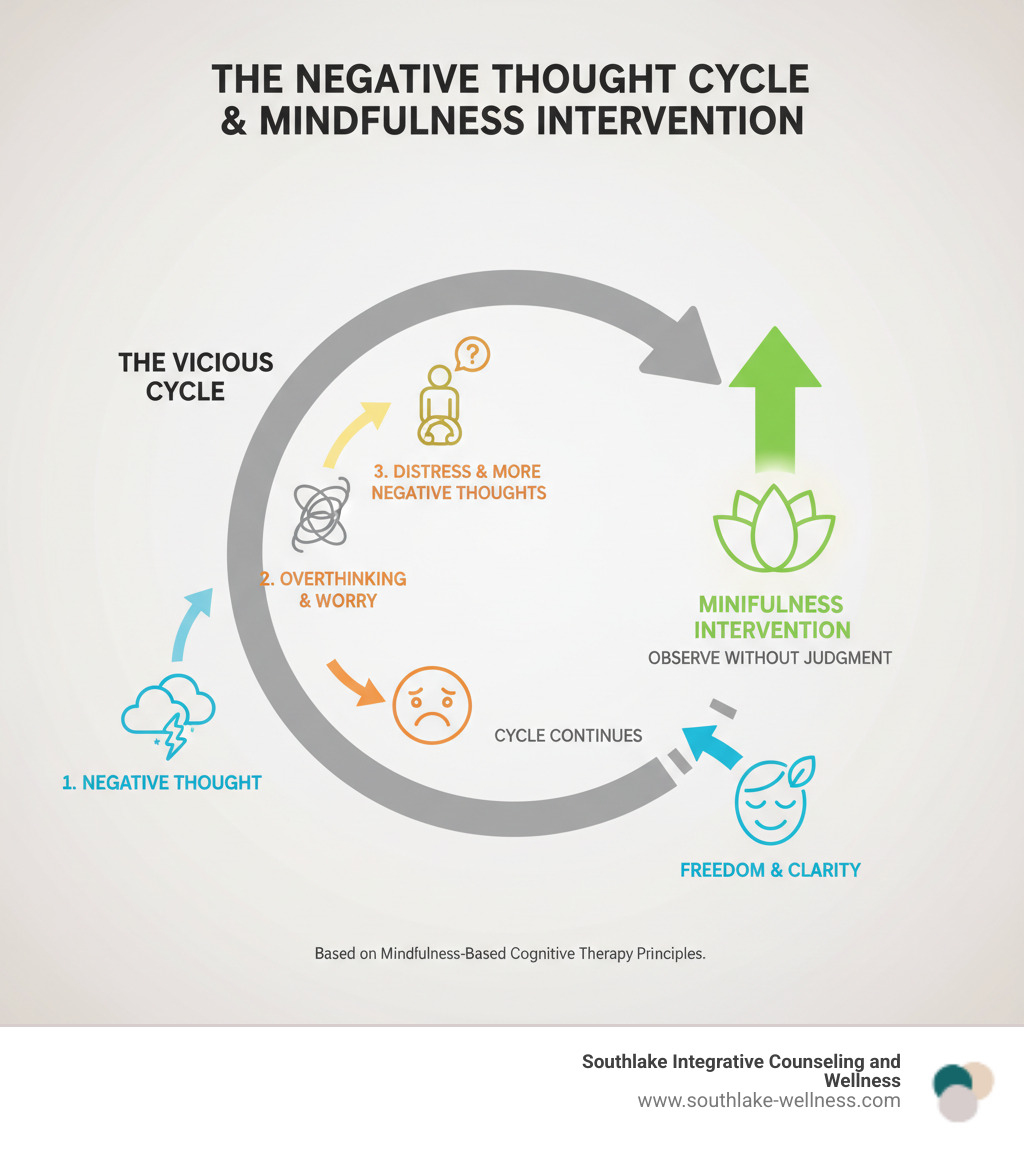
When a low mood strikes, the mind often jumps to catastrophic thinking: "Oh no, I'm falling back into depression." This thought fuels more negative thoughts, creating a downward spiral. MBCT interrupts this automatic connection.
The key mechanism is decentering: learning to observe your thoughts and feelings as temporary mental events rather than absolute truths. Instead of being fused with the thought "I'm worthless," you learn to see it as, "I'm having the thought that I'm worthless." This small shift creates space and reduces the thought's power.
This process dramatically reduces rumination—the habit of chewing on negative thoughts. By recognizing rumination and gently redirecting your attention to the present, you step off the mental hamster wheel. Research confirms the benefits: for people with a history of depression, MBCT reduces the risk of relapse by approximately 50%.
By practicing mindfulness based therapy, you train your brain to pause and choose how to respond to difficulty, rather than reacting automatically.
MBCT vs. MBSR vs. CBT: Understanding the Differences
Let's clarify the differences between these common therapeutic approaches.
- Mindfulness-Based Stress Reduction (MBSR): Developed by Jon Kabat-Zinn, this is a general wellness program that uses mindfulness to help anyone manage stress and chronic pain. Its focus is broad well-being.
- Cognitive Behavioral Therapy (CBT): This traditional therapy focuses on identifying and changing negative thought patterns. The approach is to challenge a negative thought, find evidence against it, and replace it with a more realistic one. CBT's motto is "change your thoughts."
- Mindfulness-Based Cognitive Therapy (MBCT): This therapy adapts MBSR practices specifically to prevent depression relapse. It targets the specific thought patterns linked to depression. Unlike CBT, mindfulness based therapy's motto is "change your relationship with your thoughts." You don't argue with a negative thought; you notice it, acknowledge it as a mental event, and let it pass without getting hooked.
All three approaches are valuable. The best fit depends on your individual needs and history. For those dealing with recurrent depression, MBCT's focus on relapse prevention is uniquely powerful.
Core Techniques and Practices in MBCT
Mindfulness based therapy is built on practical, teachable skills that act as tools for your mental wellness. These practices help you build a stronger, more compassionate relationship with your mind.

Formal Meditation Practices
Formal practices involve setting aside dedicated time to strengthen your awareness muscles.
- Body Scan Meditation: You lie down and systematically bring your attention to different parts of your body, from toes to head. The goal is simply to notice any sensations—tightness, warmth, tingling—without judgment. This practice reconnects you with your body's signals.
- Sitting Meditation: Using your breath as an anchor, you sit comfortably and focus on its natural rhythm. When your mind wanders (which it will), you gently guide your attention back to the breath. Each time you do this, you build your capacity to observe thoughts without getting entangled in them.
- Mindful Breathing: This is a portable reset button you can use anywhere. Simply bring your attention to the physical sensations of your breath for a few moments to ground yourself in the present.
- Mindful Movement: This often involves gentle yoga or stretching, where you pay close attention to the sensations in your body as it moves. It's an excellent option if sitting still feels difficult.
- The 3-Minute Breathing Space: This powerful practice has three steps: 1) Check in and notice your current thoughts, feelings, and sensations. 2) Gather your attention by focusing on your breath. 3) Expand your awareness to your whole body. It creates a crucial pause between a trigger and your response.
Informal Mindfulness Practices
Informal practice is about bringing present-moment awareness to everyday activities, turning routine moments into opportunities for mindfulness.
- Mindfulness in Daily Activities: Bring your full attention to routine tasks like brushing your teeth or washing dishes. Notice the sensations, sounds, and movements involved, stepping out of autopilot mode.
- Mindful Walking: Pay attention to the physical experience of walking—the feeling of your feet on the ground, the swing of your arms, the sights and sounds around you—without getting lost in thought.
- Mindful Eating: Engage all your senses while you eat. Notice the colors, smells, textures, and flavors of your food. This not only improves enjoyment but also helps you recognize your body's hunger and fullness cues.
- Awareness of Pleasant and Unpleasant Events: Throughout your day, pause to savor pleasant moments. When unpleasant feelings arise, acknowledge them without trying to push them away or getting swept up in a story about them.
Cognitive Therapy Elements in mindfulness based therapy
The "cognitive" part of MBCT provides context for why these mindfulness practices are so effective.
- Psychoeducation on Depression: You learn about the mind's different modes, such as "doing mode" (goal-oriented) and "being mode" (accepting and aware). Applying "being mode" to your inner world is a core shift in mindfulness based therapy.
- Identifying Triggers and Developing an Action Plan: You become aware of the situations or thoughts that tend to start a downward spiral. This allows you to create a personalized relapse prevention plan, helping you respond mindfully when you notice early warning signs.
- Recognizing Thoughts as Mental Events: This is the essence of decentering. Instead of automatically believing the thought "I'm a failure," you learn to observe it: "I'm having the thought that I'm a failure." This shift robs the thought of its power, allowing you to see it as a transient mental event rather than an absolute truth.
Conditions, Benefits, and Effectiveness of Mindfulness-Based Therapy
At Southlake Integrative Counseling and Wellness, we've seen how mindfulness based therapy creates profound, lasting shifts. It’s not just about managing symptoms—it’s about building resilience from the inside out.

What Conditions Can MBCT Help Address?
While originally designed for recurrent depression, MBCT's skills are remarkably helpful for a wide range of challenges.
- Recurrent Depression: It remains the gold standard for preventing relapse by teaching you to recognize and skillfully respond to early warning signs.
- Anxiety Disorders: You learn to observe anxious thoughts and physical sensations without getting swept away, which can be incredibly liberating for those with generalized anxiety, social anxiety, or panic disorder.
- Bipolar Disorder: In remission, MBCT helps maintain emotional stability by addressing the depressive and anxious symptoms that can trigger episodes.
- Chronic Pain & Fibromyalgia: It offers a new way of relating to physical discomfort. By learning acceptance and non-reactivity, many find that pain's impact on their quality of life decreases.
- Substance Use Disorders: By becoming aware of urges without automatically acting on them, individuals develop greater freedom and choice. One study showed mindfulness practice helped smokers reduce cigarette use by 60%.
- PTSD: The grounding, present-moment focus helps reduce hyperarousal and provides tools for processing trauma with greater stability.
- Chronic Health Conditions: MBCT helps alleviate the anxiety and frustration that often accompany managing illnesses like diabetes, cancer, or vascular disease. For a deeper look, explore this overall review of mindfulness-based interventions.
The Proven Benefits of Practicing MBCT
Beyond treating specific conditions, mindfulness based therapy cultivates fundamental life skills that improve overall well-being.
- Improved Emotional Regulation: You develop the capacity to observe intense emotions without being overtaken, allowing for more thoughtful responses.
- Reduced Stress Reactivity: You become more attuned to your body's early stress signals, allowing you to intervene before stress escalates.
- Improved Self-Awareness: You begin to recognize your own habitual patterns, which is the first step toward changing them.
- Increased Self-Compassion: You learn to approach your own difficulties with the kindness you would offer a friend.
- Better Focus and Concentration: Regular practice strengthens your attentional muscles, helping you stay present.
- Deeper Appreciation for Life: By being more present, you notice and savor the joy in simple moments.
A meta-analysis confirmed these benefits, showing that mindfulness-based interventions produce a 30–60% decrease in depressive and anxious symptoms.
How Effective is mindfulness based therapy?
The evidence supporting mindfulness based therapy is robust and impressive.
- As Effective as Medication: For people with recurrent depression, MBCT performs as effectively as maintenance antidepressant medication in preventing relapse. This offers a powerful alternative or complement to long-term medication.
- Comparable to CBT: MBCT's effectiveness is comparable to cognitive-behavioral therapy (CBT), another gold-standard treatment.
- Outperforms Other Approaches: MBCT consistently outperforms non-evidence-based treatments like general health education or basic relaxation training.
- Helps with Treatment-Resistant Depression: Even for those who haven't responded well to other treatments, MBCT can help change their relationship with persistent symptoms, reducing suffering and building resilience.
- Cost-Effective: By preventing relapses and teaching sustainable skills, MBCT reduces the need for repeated acute care over the long term.
What to Expect and How to Get Started
Taking the first step toward mindfulness based therapy is an act of self-care. Understanding the process can make the journey feel more inviting.
The Structure of an MBCT Program
MBCT follows a refined, structured format. The typical program includes:
- An 8-week duration with weekly group sessions.
- 2 to 2.5-hour sessions that include guided meditation, learning, and group discussion.
- An all-day silent retreat around week five or six to deepen your practice in a supportive environment.
- A daily home practice commitment of 30 to 45 minutes. This is where the real change happens, as you build new neural pathways.
- Group discussion and inquiry, where you share insights and realize you're not alone in your struggles.
Finding a Qualified MBCT Practitioner
Finding the right practitioner is key. In Texas, look for licensed mental health professionals like Licensed Professional Counselors (LPC), Licensed Clinical Social Workers (LCSW), or psychologists (Ph.D., Psy.D.).
Crucially, seek a practitioner with dedicated MBCT training and certification. Don't hesitate to ask about their background. It's also essential that your practitioner has their own established mindfulness practice, as they can only guide you from a place of personal experience.
When considering a therapist, ask about their MBCT training, how they structure sessions, and their approach to supporting home practice. Most importantly, trust your gut—the therapeutic relationship is a vital part of healing.
Taking the First Step
Ready to begin? Here are some practical next moves:
- Speak with your doctor or current mental health provider. They can offer valuable input on whether mindfulness based therapy is a good fit for you, especially if you are taking medication.
- Research qualified practitioners.
- Explore our programs. At Southlake Integrative Counseling and Wellness, we offer MBCT group programs that combine a structured curriculum with the power of healing in a community. You can learn more about our Mindfulness Based Group Therapy on our website.
- Start with self-help. If you're not ready for a full program, self-help books can be a gentle introduction to mindfulness concepts.
There's no perfect time to start. If you're reading this, some part of you is ready to explore a different way of relating to your mind. That's enough to begin.
Frequently Asked Questions about Mindfulness-Based Therapy
It's natural to have questions about mindfulness based therapy. Here are answers to some of the most common concerns we hear at Southlake Integrative Counseling and Wellness.
Is MBCT a replacement for medication?
MBCT is typically not a replacement for medication, but rather a powerful complement to it. For people with recurrent depression, research shows MBCT can be as effective as maintenance antidepressant medication in preventing relapse.
However, this is a critical point: any decision about adjusting or tapering off medication must be made in close consultation with your prescribing doctor or psychiatrist. Never make these changes on your own. Some people find MBCT helps them transition off medication, while others find the combination works best.
Our integrative mental health philosophy means we collaborate with your other healthcare providers to create a comprehensive and effective treatment plan.
Can I learn MBCT on my own?
While self-help books are a great introduction, learning MBCT on your own is not recommended as a substitute for a structured program with a trained instructor.
A qualified practitioner does more than lead meditations; they provide a theoretical framework, help you steer difficulties that arise in practice, and offer personalized guidance. This expert support is crucial for practicing safely and effectively.
Furthermore, the group support dynamic is profoundly healing. Sharing experiences in a group reduces the sense of isolation that often accompanies depression and anxiety. You realize you are not alone, which is a powerful part of the healing process itself.
Is mindfulness just a trend?
It's a fair question, but the answer is a resounding no. While the word "mindfulness" is popular now, the practice is anything but a fad.
- Ancient Roots: Mindfulness is a time-tested practice with roots in Buddhist traditions dating back over 2,500 years.
- Scientific Validation: Beginning in the 1970s with Jon Kabat-Zinn's MBSR program, mindfulness has been subjected to decades of rigorous, peer-reviewed research demonstrating its effectiveness for a wide range of physical and mental health conditions.
- Mainstream Integration: As noted by sources like the American Psychological Association regarding the mindfulness trend in psychotherapy, mindfulness-based approaches are now recognized as a major "third wave" of cognitive-behavioral therapies.
Mindfulness is having a cultural moment because its profound, evidence-based benefits are finally receiving the recognition they deserve.
Conclusion: Embracing a New Relationship with Your Mind
Mindfulness based therapy is not about achieving a perfect state of zen. It's about fundamentally shifting how you experience your own mind. Instead of being at the mercy of every anxious thought, you learn to step back and observe with kindness and curiosity.
You are not your thoughts; you are the awareness that notices them. This simple realization is life-changing.
Through practices like the body scan and the three-minute breathing space, you develop tangible skills to interrupt automatic negative patterns and sit with discomfort without being overwhelmed. The research confirms the results: a nearly 50% reduction in depression relapse risk and effectiveness comparable to maintenance antidepressants.
At Southlake Integrative Counseling and Wellness, we are passionate about this approach because it empowers you. We don't just teach mindfulness in isolation; we give you a long-term mental wellness toolkit by integrating MBCT with other evidence-based therapies in a personalized plan that honors your unique journey.
If you're struggling with recurrent depression, anxiety, or chronic stress, mindfulness based therapy offers a proven path forward. It's a worthwhile journey, and you don't have to walk it alone.
We invite you to take that courageous first step. Find more info about our holistic therapy services and see how our integrative approach can help you cultivate lasting emotional resilience right here in Southlake, Texas.
Your mind doesn't have to be your enemy. With awareness, practice, and support, it can become your greatest ally. Let's begin this journey together.
Mindfulness based therapy works only if you practice it consistently. Insight without action changes nothing. At Southlake Integrative Counseling and Wellness, we focus on helping you turn mindfulness into a daily skill, not just an idea you understand intellectually. With the right guidance, structure, and commitment, you can stop reacting on autopilot and start responding with clarity, stability, and control.