
Introduction: Reconnecting with Your Plate
Mindfulness based eating awareness is a structured approach that combines meditation practices with eating awareness to help you develop conscious food choices, recognize hunger and satiety cues, and reduce emotional or binge eating—without restrictive dieting.
Quick Overview: What You'll Learn
- What it is: A 12-week program (MB-EAT) using focused meditation to normalize eating behaviors
- Core practices: Body scans, hunger/satiety awareness, guided eating meditations, emotional trigger identification
- Proven results: 86% of studies show reduced binge eating, improved self-control, and decreased depression
- Who benefits: Anyone struggling with binge eating, emotional eating, weight concerns, or wanting a healthier relationship with food
- Key difference: Focuses on internal cues and self-acceptance, not external rules or restriction
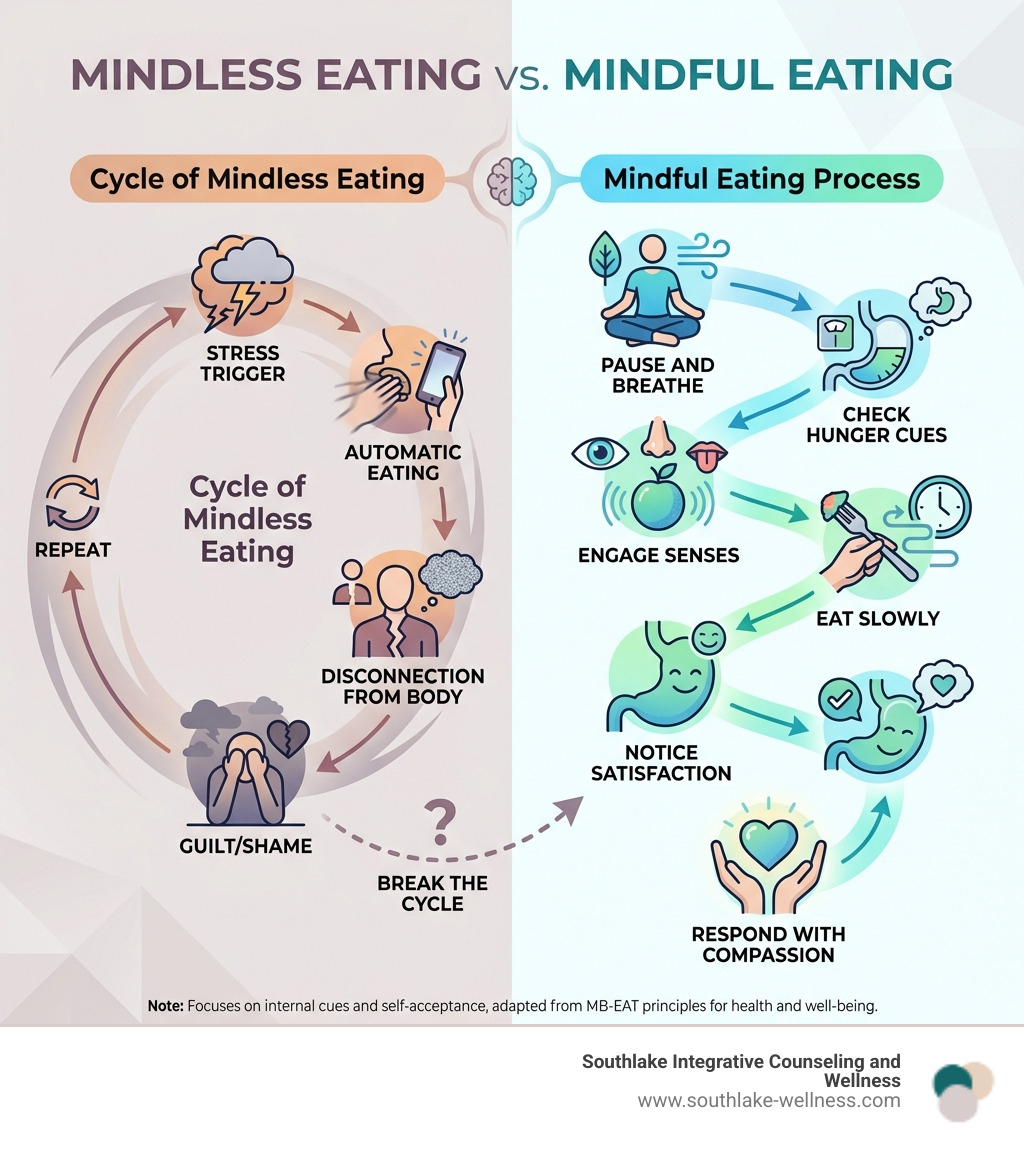
How many times have you finished a meal and barely remembered tasting it? Maybe you were scrolling through your phone, rushing through lunch at your desk, or eating while stressed about tomorrow's deadline. Mindless eating has become the norm—we disconnect from the very act that nourishes us.
Research shows that when our attention isn't focused on eating, our digestive process becomes 30-40% less effective. We miss our body's fullness signals. We eat past satisfaction. And we lose the simple pleasure of tasting our food.
This isn't about willpower or another diet plan. It's about reconnecting with your senses.
Mindfulness based eating awareness training (MB-EAT) offers a different path. Developed through decades of research and adapted from programs at the University of Massachusetts Medical School, it teaches you to:
- Distinguish between physical hunger and emotional cravings
- Make food choices from a place of inner wisdom rather than external rules
- Respond to stress without turning to food
- Actually enjoy eating again
The evidence is compelling. In studies with over 1,160 participants, mindfulness-based interventions showed moderate effectiveness for weight management and significant reduction in binge eating and emotional eating. In adolescents, adapted programs (MB-EAT-A) increased exercise by 1.4 days per week and improved consumption of low-calorie, low-fat foods—all without restrictive dieting.
Unlike traditional diet culture, which focuses on what you can't eat, mindfulness based eating awareness cultivates awareness of how and why you eat. It's weight-inclusive, non-judgmental, and grounded in self-acceptance.
As experienced counselors specializing in areas like trauma, addiction, and anxiety, we see how deeply these issues intersect with our relationship to food. By integrating mindfulness based eating awareness principles with evidence-based approaches like Cognitive Behavioral Therapy (CBT) and Dialectical Behavioral Therapy (DBT), we help clients break cycles of emotional eating and develop lasting, healthy patterns that support both mental and physical well-being. Whether you're managing stress eating, recovering from binge episodes, or simply want to slow down and savor your meals, this journey starts with awareness.
Understanding Mindfulness-Based Eating Awareness Training (MB-EAT)
Mindfulness-Based Eating Awareness Training (MB-EAT) is a comprehensive, 12-week manualized intervention designed to help individuals normalize their eating behaviors and cultivate a healthier relationship with food. It uses focused meditation techniques and guided practices to address the root causes of disordered eating, rather than imposing external rules or restrictive diets.
The journey of MB-EAT began in the mid-1990s with initial research by Dr. Jean Kristeller and Brendan Hallett (Kristeller & Hallett, 1999). Building on established mindfulness programs, they developed an intervention that integrated core mindfulness principles with the specific challenges of eating. This foundational work paved the way for significant funding from the National Institutes of Health (NIH), leading to further development and research in collaboration with institutions like Duke University, Ohio State University, and the University of California-San Francisco. Dr. Kristeller has been a pivotal figure throughout this development, shaping MB-EAT into the evidence-based program it is today.
The primary goal of MB-EAT is not weight loss itself, but rather the normalization of eating behaviors. This means helping individuals develop a more balanced and intuitive approach to food, where choices are guided by internal wisdom rather than external pressures or emotional impulses. It accepts a non-diet, weight-inclusive approach to health, focusing on well-being and self-acceptance, regardless of body size.
How MB-EAT Differs from Traditional Diets
Traditional dieting often relies on external rules, calorie counting, and strict restrictions, leading to a cycle of deprivation, cravings, and often, eventual overeating or bingeing. MB-EAT offers a refreshing alternative by shifting the focus inward.
FeatureMindfulness-Based Eating Awareness (MB-EAT)Traditional DietingFocusInternal cues (hunger, fullness, satisfaction), body sensations, thoughts, emotions, and the eating experience. Cultivates a mindful relationship with food.External rules (calorie limits, forbidden foods, portion sizes), weight goals, rapid results. Views food as "good" or "bad."ApproachNon-diet, weight-inclusive, self-compassionate. Emphasizes awareness, acceptance, and gentle curiosity.Restrictive, often judgmental, focused on control and deprivation.GoalNormalizing eating behaviors, improving self-control, reducing emotional/binge eating, enhancing psychological well-being, cultivating self-acceptance. Aims for sustainable, flexible eating patterns.Primarily weight loss, often rapid.Relationship to FoodLearning to trust your body's signals, enjoying food without guilt, making conscious choices based on well-being.Often creates a fraught relationship with food, leading to feelings of failure, guilt, and obsession.LongevityTeaches lifelong skills for mindful living and eating, fostering a stable, healthy relationship with food and body.Often short-lived, leading to yo-yo dieting and rebound weight gain.
The Core Principles of Mindfulness Based Eating Awareness
At the heart of mindfulness based eating awareness are several key principles that guide participants toward a more conscious and fulfilling eating experience:
- Cultivating Awareness: This involves intentionally paying attention to the present moment—the sights, smells, textures, and tastes of food, as well as the thoughts, feelings, and physical sensations that arise before, during, and after eating. This heightened awareness helps us break free from automatic, mindless eating patterns.
- Inner Wisdom: MB-EAT encourages us to tune into our body's innate wisdom regarding hunger, fullness, and satisfaction. Rather than relying on external diet rules, we learn to trust our internal signals, making food choices that truly nourish and satisfy us. The concept of a "wise self" helps us make choices that align with our deepest values and well-being.
- Outer Wisdom: While emphasizing inner wisdom, MB-EAT also integrates practical "outer wisdom" related to nutrition and physical activity. This includes understanding healthy eating principles and incorporating mindful exercise, always from a place of self-care and gentle exploration rather than rigid adherence. For instance, some programs incorporated a "500 Calorie Challenge" to help participants identify sustainable calorie reductions in their daily lives.
- Self-Acceptance: A crucial component, self-acceptance involves approaching our eating behaviors and body with kindness and non-judgment. This includes practices like the "Forgiveness meditation" introduced in early MB-EAT research, which helps cultivate compassion for ourselves and our past struggles.
- Making Conscious Food Choices: By being more aware, we move from reactive eating to responsive eating. We learn to pause, assess our true needs, and choose foods that serve our well-being, rather than succumbing to emotional urges or external triggers.
Who Can Benefit from MB-EAT?
Mindfulness based eating awareness is a versatile and powerful tool for a wide range of individuals seeking to transform their relationship with food. Our holistic approach at Southlake Integrative Counseling and Wellness aligns perfectly with these principles, offering support for anyone in the Southlake, TX area who resonates with these challenges.
- Binge Eating Disorder (BED): MB-EAT was initially developed and extensively researched as an intervention for binge eating disorder. Research consistently shows its value in "decreasing binge episodes, improving one's sense of self-control with regard to eating, and diminishing depressive symptoms" (Kristeller & Hallett, 1999; Kristeller, Wolever & Sheets, 2013). This is a core area where MB-EAT shines.
- Overeating and Weight Concerns: For individuals struggling with chronic overeating or weight management issues, MB-EAT offers a sustainable alternative to restrictive diets. Studies have shown that participants in MB-EAT programs experienced "consistent weight loss, with some individuals losing as much as 25 lbs. — and keeping it off" (Kristeller & Wolever, 2011). It helps foster healthy eating patterns without the focus solely being on the number on the scale.
- Type-2 Diabetes: The program has been specifically "adapted for treatment of type-2 diabetes" (Miller, Kristeller, Headings et al., 2012; 2014), demonstrating its utility in managing health conditions linked to eating behaviors.
- Emotional Eating and Stress-Related Eating: If you find yourself reaching for food when stressed, sad, bored, or anxious, MB-EAT can be profoundly helpful. It trains individuals in "controlling responses to emotional states" (Kristeller & Wolever, 2011), helping to identify triggers and develop healthier coping mechanisms.
- Anyone Seeking a Healthier Relationship with Food: Even if you don't have a diagnosed eating disorder, but feel disconnected from your body's signals, struggle with guilt around food, or simply want to savor your meals more, MB-EAT offers a path to greater peace and enjoyment in your eating life.
The Science of Mindful Eating: Proven Benefits

The effectiveness of mindfulness based eating awareness isn't just anecdotal; it's backed by rigorous scientific research. The underlying premise is that by cultivating awareness and intentionality, we can rewire our relationship with food and our bodies.
Evidence-based results consistently highlight the positive impact of MB-EAT:
- Decreased Binge Episodes: One of the most significant findings is the reduction in binge eating. Research using MB-EAT programs has found "positive effects for decreasing binge episodes" (Kristeller & Hallett, 1999). Early studies showed "significant improvements in binges/week" for participants.
- Improved Self-Control: Participants often report "improving one's sense of self-control with regard to eating" (Kristeller, Wolever & Sheets, 2013). This isn't about rigid control, but rather an empowered sense of choice and agency over one's eating habits.
- Reduced Depressive Symptoms: The benefits extend beyond eating behaviors to mental well-being, with studies showing "diminishing depressive symptoms" (Kristeller, Wolever & Sheets, 2013). This holistic improvement underscores the mind-body connection inherent in mindfulness.
- Long-Term Consistency: A key challenge in any eating intervention is sustaining changes. MB-EAT has shown promising results in this area, with some individuals losing weight and "keeping it off" (Kristeller & Wolever, 2011), indicating long-term behavioral shifts.
Research-Backed Benefits of Mindfulness Based Eating Awareness in Adults
Beyond reducing binge eating and depression, mindfulness based eating awareness offers several other compelling benefits for adults:
- Weight Management Without Restrictive Dieting: Unlike conventional diets that often lead to a rebound effect, MB-EAT fosters sustainable changes. Studies have shown "consistent weight loss" without the typical "gaining any meaningful weight" back, with some participants losing "as much as 25 lbs." and maintaining it (Kristeller & Wolever, 2011). This approach prioritizes a healthy relationship with food over rigid weight goals.
- Improved Glucose Metabolism: For individuals with type-2 diabetes, MB-EAT has demonstrated an ability to "improve post-prandial glucose metabolism independent of weight change" (Best, Quillian-Wolever & Sheets, 2006). This suggests a direct physiological benefit from mindful eating practices beyond just weight changes. The Harvard Nutrition Source also notes that mindful eating can lead to "maintenance of fasting blood glucose."
- Reduced Stress Eating: By teaching participants to "control responses to emotional states" (Kristeller & Wolever, 2011), MB-EAT helps individuals break the cycle of using food as a coping mechanism for stress.
- Lower Cortisol Levels: Research indicates that mindfulness interventions for stress eating can "reduce cortisol and abdominal fat" among overweight and obese women (Daubenmier et al., 2011, cited in Kristeller & Epel, 2014). Cortisol, the stress hormone, is often implicated in weight gain and fat storage, especially around the abdomen.
- Increased Psychological Well-being: The impact of MB-EAT extends to broader psychological health. The integration of mindfulness, wisdom, and spirituality within the program has been linked to increased spiritual well-being, specifically in "Meaning/Peace and Faith factors" (Kristeller, Wolever & Sheets, 2013 research paper). These factors, in turn, are associated with a reduction in depressive and anxious symptoms.
Adapting for Younger Generations: MB-EAT for Adolescents (MB-EAT-A)

Childhood and adolescent overweight and obesity are pressing public health concerns. The prevalence of obesity in U.S. children and adolescents was estimated at 16.9%, with a disproportionate impact on certain demographics, such as 37% of non-Hispanic African American adolescents being at-risk for overweight or overweight in 2003-2004 (Barnes, Kristeller, Shenbagarajan, 2008). Overweight youth face increased risks for "adult" conditions like type 2 diabetes, hypertension, and significant "psychological impairment" (Barnes, Kristeller, Shenbagarajan, 2008).
Adolescents often face unique challenges, including body image issues, social pressures, and the development of disordered eating patterns like binge eating. Studies show that "binge eating in obese children and adolescents" is a real concern (Decaluwe & Braet, 2003). In one sub-sample of 29 African American adolescents, 58% reported having a binge eating problem, which was mostly mild to moderate in severity.
Recognizing this need, the MB-EAT program was "adapted for adolescents" (MB-EAT-A) and successfully implemented as a 12-week manualized intervention in high school settings (Barnes, Kristeller, Shenbagarajan, 2008). The results were encouraging:
- Increased Exercise: The MB-EAT-A group showed a significant increase in physical activity, adding 0.8 days of moderate and 1.4 days of intense aerobic exercise per week, respectively (Barnes, Kristeller, Shenbagarajan, 2008).
- Improved Dietary Habits: Participants in the MB-EAT-A program also improved their dietary habits, favoring low-calorie and low-fat foods. On average, they increased their weekly consumption of low-calorie foods by 7.7 servings, foods with no saturated fats by 5.1 servings, low-saturated-fat foods by 4.6 servings, and low-fat foods by 5.8 servings (Barnes, Kristeller, Shenbagarajan, 2008).
- Binge Eating in Adolescents: While 58% of a particular sub-sample reported binge eating, the severity of these issues "did not significantly correlate with anxiety, depression, or self-esteem," though it did correlate with a "poorer attitude towards school" (Barnes, Kristeller, Shenbagarajan, 2008). This highlights the complex interplay of factors affecting adolescent eating behaviors.
These findings suggest that mindfulness based eating awareness can be effectively custom for younger populations, providing them with essential tools to steer the complexities of food choices and body image during formative years.
How to Practice Mindful Eating: A Step-by-Step Guide
Ready to transform your relationship with food? Practicing mindfulness based eating awareness is a journey, not a destination. It requires patience, curiosity, and a willingness to explore. Here’s a step-by-step guide to get you started, whether you're in Southlake, TX or anywhere else.
Step 1: The Foundational Meditations
Before we even get to the food, the foundation of mindful eating is general mindfulness practice. "Mindfulness is the aware, balanced acceptance of the present experience," as Sylvia Boorstein wisely put it, "opening to or receiving the present moment... without either clinging to it or rejecting it." It's about an "intentional focus on one’s thoughts, emotions, and physical sensations in the present moment" (Harvard Nutrition Source).
- Focused Meditation Techniques: Start with short, regular meditation sessions. This could be a 5-10 minute sitting meditation focusing on your breath. Notice the sensation of your breath entering and leaving your body. When your mind wanders (and it will!), gently bring your attention back to your breath. This builds the mental muscle for awareness.
- Body Scan Meditation: Lie down or sit comfortably and systematically bring your attention to different parts of your body, noticing any sensations without judgment. This practice improves interoceptive awareness, helping you tune into your body's physical cues, including hunger and fullness.
- Cultivating Non-Judgment: This is crucial. When you notice thoughts or feelings, simply observe them without labeling them "good" or "bad." Mindfulness based eating awareness addresses the shame and guilt often associated with eating behaviors by promoting a non-judgmental attitude. This compassionate stance is key to lasting change.
Step 2: Tuning into Hunger and Satiety Cues
One of the biggest shifts in mindful eating is learning to differentiate between physical hunger and emotional hunger. We often eat out of habit, boredom, or stress, rather than true physiological need.
- The Hunger-Satiety Scale (1-10): Before you eat, take a moment to assess your hunger on a scale of 1 (famished) to 10 (stuffed). Aim to eat when you're around a 3 or 4 (pleasantly hungry) and stop when you're around a 6 or 7 (pleasantly satisfied, not stuffed).
- Recognizing Physical Hunger vs. Emotional Hunger: Physical hunger develops gradually, often accompanied by stomach rumbling or lightheadedness. Emotional hunger, on the other hand, comes on suddenly, often feels urgent, and craves specific comfort foods. As the Harvard Nutrition Source suggests, "If you find yourself standing in your pantry or staring in your refrigerator, pause and ask yourself: “am I truly hungry, or am I just bored or stressed?” If hungry, eat. If boredom or stress is the source, reroute your attention to an activity you enjoy, call a friend, or simply spend some time breathing."
- Eating to 80% Full: Instead of eating until you're completely full, aim for a feeling of comfortable satisfaction. "Recognize when you are feeling satisfied, or about 80% full, and stop eating" (Harvard Nutrition Source). This leaves you feeling energized, not sluggish. This ties into "sensory-specific satiety," where our bodies register fullness more effectively when we're paying attention to the food's sensory qualities (Guinard & Brun, 1998). When we're disengaged, we are less aware of our body's fullness signals and may overeat.
Step 3: The Mindful Bite
Now for the fun part: bringing your full attention to the act of eating! This is where we engage all our senses to truly experience and savor our food.
Here’s a simple mindful eating exercise you can try with any food, like a piece of fruit, a cracker, or even just a single bite of your meal:
- Observe: Pick up the food. What do you see? Notice its colors, shape, texture, and any patterns. Take a moment to truly appreciate its appearance.
- Smell: Bring the food close to your nose. What scents do you detect? Are there subtle aromas you hadn't noticed before?
- Touch: How does it feel in your hand? Is it smooth, rough, soft, firm? If appropriate, notice its temperature.
- Sound: As you bring the food to your mouth, or as you bite into it, are there any sounds? A crunch, a squish, a gentle rustle?
- Taste: Place the food in your mouth. Don't chew immediately. Let it rest on your tongue. What flavors do you notice? How do they change as you gently chew? "Savor small bites, and chew thoroughly" (Harvard Nutrition Source). A common practice is to chew each bite of food 10-15 times, paying close attention to the changes in taste and texture.
- Slowing Down: Put your utensil down between bites. Take a breath. This simple act can dramatically slow your eating pace, allowing your brain time to register fullness. Setting down your utensils between bites creates a natural pause, giving your body time to register fullness and helping you feel satiated faster.
- Notice Sensations: As you swallow, follow the food's journey. How does your body feel? Do you feel more satisfied? "Observe how the food looks, tastes, smells, and feels in our bodies as we eat" (Harvard Nutrition Source).
By engaging all your senses and slowing down, you'll find that even a small amount of food can be incredibly satisfying. You might even find yourself saying, "Wow, I didn't realize how delicious that was!"
Step 4: Navigating Emotional and Environmental Triggers
Our eating behaviors are often deeply intertwined with our emotions and environment. Mindfulness based eating awareness helps us untangle these connections.
- Identifying Emotional Triggers: We all have them. That urge to grab a snack when boredom strikes, or to indulge in comfort food after a stressful day. MB-EAT teaches us "controlling responses to emotional states" (Kristeller & Wolever, 2011). When a craving for comfort food arises, the Harvard Nutrition Source suggests, "pause and take a few in-breaths and out-breaths to be fully present with your craving." Acknowledge the emotion without immediately reacting with food.
- Developing Coping Responses Without Food: Once you identify an emotional trigger, you can consciously choose a different response. If "boredom or stress is the source, reroute your attention to an activity you enjoy, call a friend, or simply spend some time breathing" (Harvard Nutrition Source). This is where our services at Southlake Integrative Counseling and Wellness can be particularly helpful, as we offer various strategies to develop coping skills guide, explore coping mechanisms for adults, and learn holistic coping strategies that don't involve food.
- Mindful Restaurant Eating: Even when dining out, you can practice mindfulness. Take a moment before you order to check in with your hunger. When your food arrives, take a moment to appreciate it before diving in. Pay attention to the conversation, the ambiance, and your food. Interestingly, "exploratory research has also found value for restaurant meals" (Kristeller & Wolever, 2011) in applying MB-EAT principles.
- Making Conscious Choices in Social Settings: Social eating can be wonderful, and "socializing with friends and family during a meal can improve an eating experience" (Harvard Nutrition Source). The key is to remain aware. You can still participate in conversations and enjoy the company while subtly checking in with your hunger and fullness cues. You don't have to announce your mindful eating practice; simply embody it.
Conclusion: Start Your Journey to Eating Awareness Today
Embracing mindfulness based eating awareness is about more than just changing what you eat; it's about changing how you eat and, ultimately, how you live. We've explored how this powerful approach can lead to decreased binge episodes, improved self-control, reduced depressive symptoms, and a more joyful, sustainable relationship with food. From adults seeking weight management and improved glucose metabolism to adolescents navigating the complexities of eating habits, the benefits are clear and research-backed.
This journey empowers you to tune into your inner wisdom, make conscious choices, and respond to life's triggers with compassion rather than automatic reactions. It's a lifelong skill that cultivates not just a healthier body, but a more peaceful mind and a deeper connection to yourself.
At Southlake Integrative Counseling and Wellness, we understand that true well-being encompasses both mind and body. Our holistic approach to mental healthcare, right here in Southlake, Texas, combines evidence-based therapies with alternative modalities to promote emotional balance and resilience. We emphasize the mind-body connection, offering personalized treatment plans for individuals, couples, and groups. If you're ready to open up your senses and cultivate a healthier relationship with food and yourself, we're here to support you.
Learn more about our holistic therapies for mind-body balance