
Reconnecting with the Present Moment
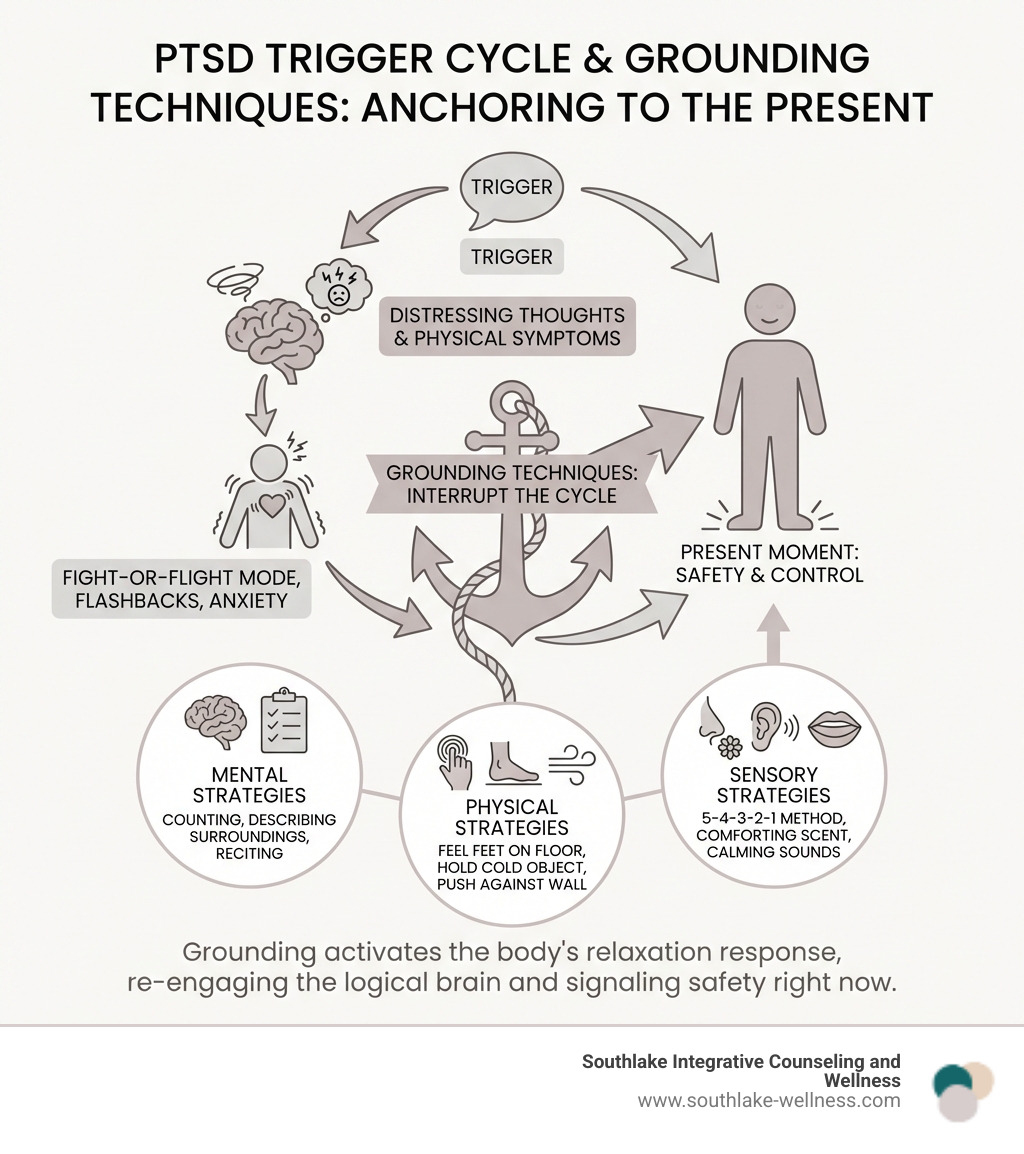
Grounding for PTSD is a set of simple, practical techniques designed to bring you back to the present moment when you're overwhelmed by flashbacks, intrusive memories, or intense anxiety. These strategies help you reconnect with your immediate surroundings by engaging your five senses, focusing your mind, or anchoring yourself physically—interrupting the trauma response cycle so you can regain a sense of safety and control.
Quick Grounding Techniques for PTSD:
- 5-4-3-2-1 Method: Name 5 things you see, 4 you can touch, 3 you hear, 2 you smell, 1 you taste
- Physical Anchoring: Feel your feet on the floor, hold a cold object, or push your hands against a wall
- Mental Distraction: Count backward from 100, recite a poem, or describe your surroundings in detail
- Sensory Focus: Smell a comforting scent, listen to calming sounds, or touch a grounding object like a smooth stone
- Breathing: Take slow, deep breaths—inhale for 4 counts, hold for 4, exhale for 6
Why Grounding Matters: Around 70% of people experience at least one traumatic event in their lifetime. For many who develop PTSD, the brain can get "stuck" in fight-or-flight mode, making past trauma feel present and real. Grounding techniques work by activating your body's relaxation response and re-engaging the logical part of your brain, signaling that you're safe right now.
Grounding isn't a cure for PTSD, but it's a powerful tool to manage symptoms like flashbacks, dissociation, panic attacks, and hypervigilance. It works best when practiced regularly—not just during a crisis—and when integrated into a comprehensive treatment plan that might include therapy approaches like Cognitive Behavioral Therapy (CBT) or Eye Movement Desensitization and Reprocessing (EMDR).
I'm Holly Gedwed, a Licensed Professional Counselor Associate with 14 years of clinical experience specializing in trauma and anxiety. I've helped countless clients integrate grounding for PTSD into their healing journey, customizing techniques to fit each person's unique needs and responses, because what works for one person may not work for another.
Understanding Grounding for PTSD: How It Works and Why It's Crucial
When we experience a traumatic event, our brain's alarm system, often referred to as the "fight-or-flight" response, can go into overdrive. For individuals with Post-Traumatic Stress Disorder (PTSD), this system can remain hyperactive, leading to intense reactions even when there's no actual threat. Grounding techniques act as an immediate reset button, helping to regulate this nervous system response and bring us back to the safety of the present moment.
Grounding is a coping strategy designed to "ground" or immediately connect you with the present. When you feel caught in the grip of fear, anxiety, or reliving a past trauma, focusing your sensations in the present moment can help you get out of those distressing thoughts and feelings. This is why it's so important for individuals with PTSD. It helps manage overwhelming symptoms like flashbacks and dissociation, which pull us away from reality and back into the traumatic experience.
By shifting our attention to the here and now, grounding techniques directly and instantaneously connect us with the present, reducing the likelihood of slipping into a full-blown flashback or dissociative episode. They are simple, practical activities that help us relax, stay present, and reconnect with what is happening around us. This process is a core component of building emotional resilience and finding balance, especially when feeling numb or overwhelmed by emotions. To explore how these skills fit within a broader present-moment approach, see our Mindfulness Based Therapy Guide and tips on how to Build Emotional Resilience.
The Science Behind Grounding
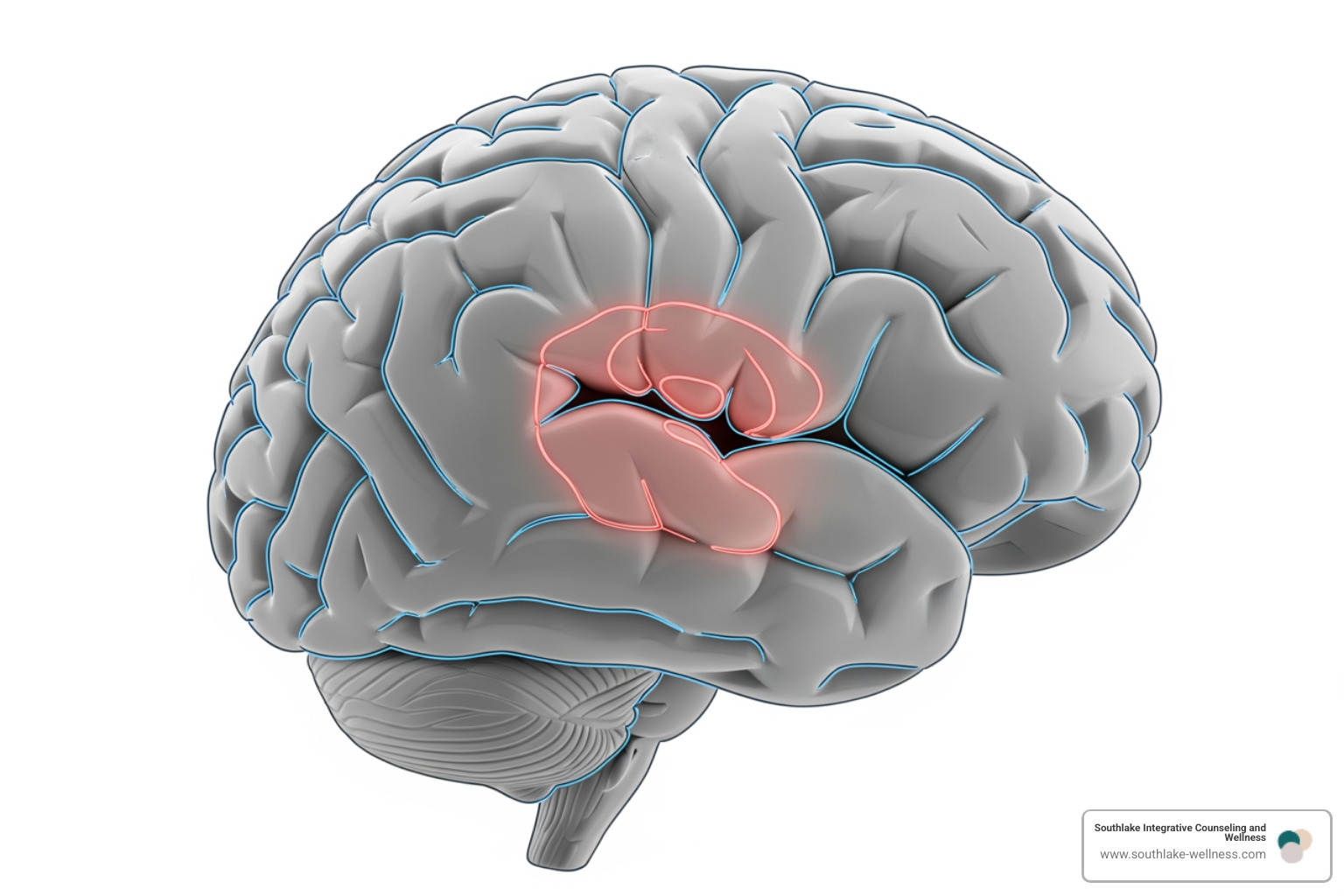
At the heart of grounding for PTSD lies a fascinating interplay between different parts of our brain. When a trigger activates a traumatic memory, our amygdala – the brain's fear center – can essentially hijack our rational thinking, leading to what's often called an "amygdala hijacking." During this, the prefrontal cortex, responsible for logic, reasoning, and present-moment awareness, takes a backseat. This can plunge us into intense emotional distress, making us feel as though the past trauma is happening all over again.
Grounding techniques work by actively re-engaging the prefrontal cortex. By consciously directing our attention to sensory input, mental tasks, or physical sensations in the present, we pull resources away from the overactive amygdala. This helps to calm the nervous system, signaling to our brain that the perceived threat is not actually present. It's a way of interrupting the trauma response by saying, "This is then, that is now. I am safe."
This process also taps into the concept of somatic experience, which emphasizes the profound connection between our mind and body. By focusing on physical sensations, we acknowledge and process the body's stored responses to trauma, helping to release tension and integrate our experiences. This mindful connection to our physical self is a powerful way to reduce hypervigilance and foster a sense of internal safety. To learn more about this connection, explore our insights on the Mind Body Wellness and Massage Therapy.
Benefits of Regular Practice
Consistent practice of grounding for PTSD offers benefits that can meaningfully improve daily life for individuals managing trauma symptoms. When incorporated into a routine, these techniques become more accessible and effective during moments of distress.
One key advantage is reduced symptom severity. By regularly interrupting the cycle of flashbacks and dissociation, we can lessen their intensity and duration over time. This leads to an increased sense of control over emotional responses, making it easier to steer challenging situations.
Regular grounding also supports improved emotional regulation. It teaches us to notice our emotions without being consumed by them, helping us find a middle ground between feeling numb and being overwhelmed. As the nervous system learns to settle more quickly, many people notice decreased anxiety and panic and better daily functioning at home, work, and in relationships. For more ways to strengthen these skills, see our Emotional Regulation Therapy Guide.
A Practical Guide to Grounding Techniques
Grounding for PTSD is a personal journey. Techniques fall into three categories: mental, physical, and sensory. Experiment to build a personalized toolkit, as what works for one person may not work for another.
Mental Grounding: Engaging Your Mind to Stay Present
Mental grounding techniques use cognitive exercises to redirect your thoughts from distressing feelings to the present. They offer a mental distraction from internal turmoil.
Here are effective mental grounding techniques:
- The 5-4-3-2-1 Method: Name 5 things you see, 4 you can feel, 3 you hear, 2 you smell, and 1 you taste.
- Thinking in Categories: Choose broad categories (e.g., "types of fruits," "car brands") and list as many items as possible.
- Simple Math Problems: Count backward from 100 by threes, or create equations for a chosen number.
- Reciting Something: Recite a poem, song lyrics, or book passage, focusing on words and rhythm.
- Describing a Common Task: Mentally walk through familiar daily tasks in detail.
- Anchoring Statements: Create and repeat: "My name is [Name]. I am [Age]. I live in Southlake, Texas. Today is [Date]. I am safe."
- Room Description: Silently describe your surroundings, noting colors, shapes, and object locations.
- Alphabet Game: Pick a topic and name one item per letter.
- Future Planning: Think through simple, neutral plans step by step.
- Gratitude Listing: Name three small things you appreciate in this moment.
Physical Grounding: Connecting with Your Body and Environment
Physical grounding techniques bring awareness to your body and its interaction with the environment. This somatic connection pulls you out of your head and into the present.
Key physical grounding techniques:
- Feel Your Feet on the Floor: Press feet firmly into the ground, noticing pressure and texture.
- Hold an Ice Cube: The intense cold sensation powerfully disrupts distressing thoughts.
- Pushing Against a Wall: Place hands flat against a wall and push firmly.
- Stretching Your Body: Slowly stretch arms, neck, and legs, noticing muscles lengthening.
- Noticing Your Breath: Inhale for four counts, hold for four, exhale for six.
- Progressive Muscle Relaxation: Systematically tense and relax muscle groups from feet to head.
- Rub Your Palms Together or Clap: Focus on sound and friction.
- Pet an Animal: The warmth and texture can be incredibly soothing.
- Take a Shower: Water sensation on skin can be very grounding.
- Physical Activity: Dance, walk, or run to release endorphins and reconnect with your body.
- Apply Cold Water: Splash on face, wrists, or neck for sudden temperature change.
For more strategies to manage stress and build resilience, explore our guide on Holistic Coping Strategies.
Using Your Five Senses for Grounding for PTSD
Engaging our five senses—sight, smell, sound, taste, and touch—is one of the most direct ways to connect with the present moment. These sensory grounding techniques are invaluable for pulling us out of an overwhelmed state.
- Sight: Look around and notice details. Name everything you see quickly. Pay attention to colors, shapes, and textures. Focus on calming photographs or something "pretty." Keep eyes open to remain aware.
- Smell: Carry essential oil (peppermint, lavender) or lavender cuttings. Light a scented candle or sniff strong peppermint. If carrying an orange, dig nails into it for sharp smell and tactile focus.
- Sound: Listen intently to surroundings. Identify three distinct sounds. Play nature sounds, call a loved one, or listen to favorite music. Use a ticking watch to control breathing.
- Taste: Carry strong-flavored candy like sour lemon drops or mints. Let chocolate melt slowly in your mouth. Bite into citrus or chew peppermint gum.
- Touch: Rub hands over furniture, notice clothing texture, or hold a smooth stone. Knead fabric in your hands. Hold ice until it melts, focusing on cold and wet sensations.
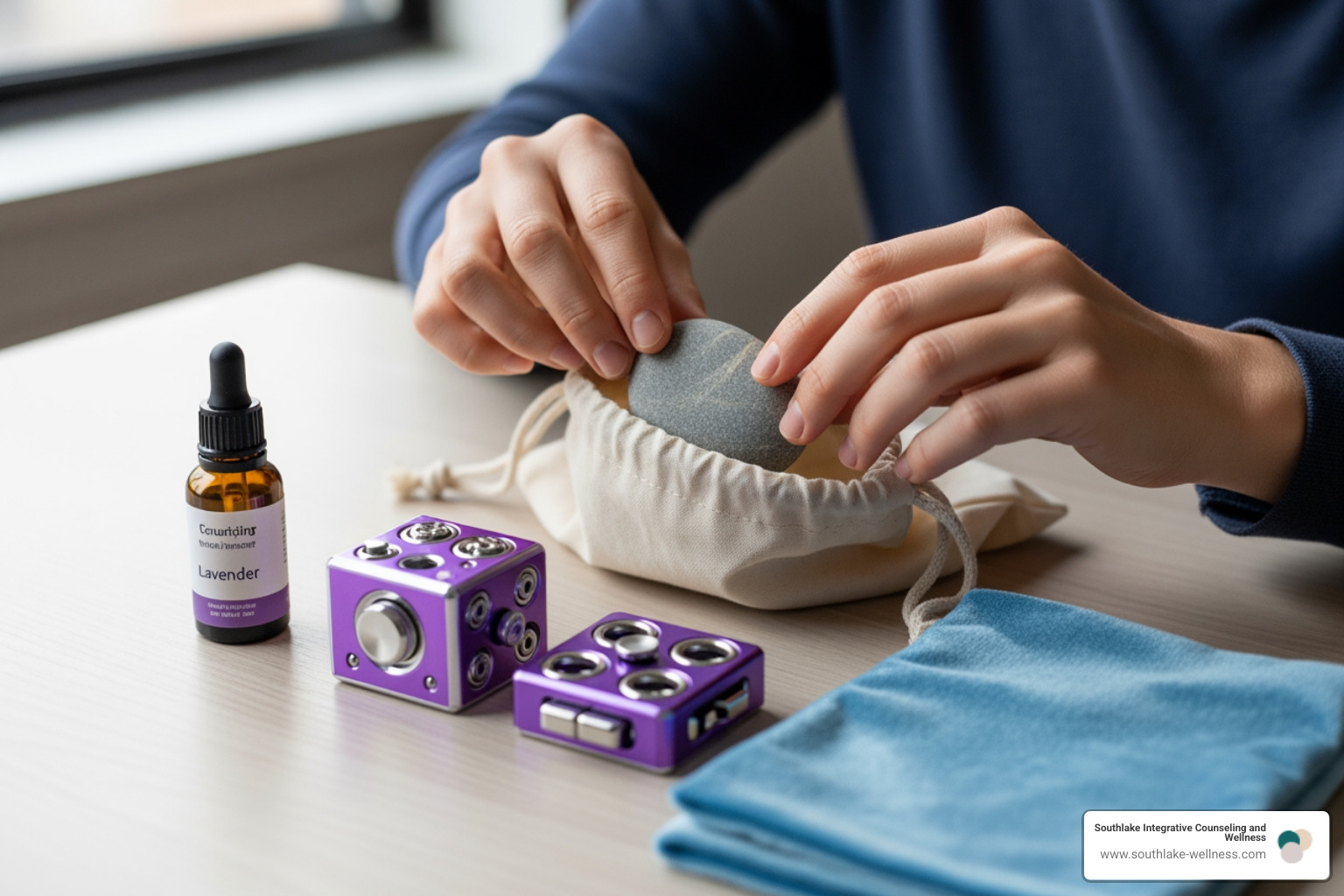
Many find comfort in a grounding object—a small item with specific meaning or pleasant texture. This could be a smooth stone, jewelry, or keepsake. Creating a small "sensory kit" with these items can be incredibly helpful to have on hand.
Integrating Grounding into Your Life and Treatment Plan
Grounding for PTSD is most effective when it's not just a crisis intervention, but a consistent practice integrated into your daily life and, ideally, into a broader mental health treatment plan. It's about personalization, consistency, and practice. We believe in Personalized Mental Health Care, recognizing that each individual's journey with trauma is unique.
Personalizing Your Grounding Toolkit for PTSD
Finding the most effective grounding techniques for you is a process of trial and error. What works for one person might not work for another, and what works today might not work tomorrow. We encourage you to experiment with different techniques from the mental, physical, and sensory categories.
Creating a grounding kit can be a wonderful way to personalize your approach. This might be a small bag or box containing items that appeal to your senses: a scented essential oil roller, a smooth stone, a small fidget toy, a picture of a loved one, or a favorite herbal tea bag. Having this kit readily available can provide immediate comfort and a reminder of your tools.
When it comes to specific trauma responses, certain techniques might be more helpful:
- Techniques for Flashbacks: Flashbacks can be terribly frightening, making you feel like the trauma is happening again. During a flashback, simple, immediate techniques are crucial. The 5-4-3-2-1 method, holding an ice cube, or pushing your feet firmly into the ground can quickly reorient you to the present. Saying an anchoring statement aloud, like "I am [Your Name], I am in [Current Location], and I am safe now," can be incredibly powerful.
- Techniques for Dissociation: Dissociation involves feeling detached from your body, emotions, or reality. Physical grounding techniques that engage strong sensations are often highly effective here. Stamping your feet, applying cold water to your face, or doing a brisk walk can help you reconnect with your physical self. Describing your surroundings in detail can also bring you back into awareness.
Throughout this process, remember the importance of self-compassion. Healing from trauma is a marathon, not a sprint. Be patient with yourself, notice small shifts, and know that every attempt to ground yourself is a step towards greater well-being. To develop more coping skills, explore our Develop Coping Skills Guide.
Challenges and Comparing Coping Strategies
While grounding for PTSD is a powerful tool, it's important to acknowledge its potential challenges and understand how it compares to other coping strategies.
A common challenge is the difficulty remembering in a crisis. When you're in the midst of a flashback, intrusive memory, or panic attack, your brain's alarm system is in overdrive, making it hard to recall or implement complex techniques. This is why simple, well-practiced techniques are most effective.
Grounding techniques are also not a substitute for professional treatment. They are designed to manage acute distress, not to resolve the underlying trauma. There might be times when techniques do not work as well as you hope, especially if the distress is very intense or if there are severe dissociative symptoms.
Let's compare grounding to other common coping strategies:
StrategyDescriptionBenefitsLimitations/RisksGroundingConsciously focusing on sensory input, mental tasks, or physical sensations to connect with the present moment.Immediate relief from acute distress, cultivates present-moment awareness, accessible anywhere.May be difficult to recall or implement during severe crises; does not address underlying trauma.AvoidanceActively trying to avoid thoughts, feelings, people, places, or situations associated with the trauma.Short-term reduction of distress.Prevents long-term healing and recovery; reinforces fear; can lead to isolation and further impairment; the harder you try to avoid memories, thoughts, or feelings, the more you may notice them.Unhealthy DistractionEngaging in activities that temporarily numb or divert attention from distress, often involving substances, excessive screen time, or compulsive behaviors.Temporary escape from pain.Does not resolve underlying issues; can lead to addiction, health problems, and further emotional suppression; often exacerbates long-term problems.Healthy DistractionEngaging in positive activities that temporarily divert attention, such as hobbies, exercise, or creative pursuits.Provides a healthy break from distress, can improve mood and well-being.Not always effective for intense acute distress; doesn't directly address or process trauma; can become a form of avoidance if not balanced with processing.Trauma ProcessingTherapeutic approaches (e.g., CBT, EMDR) that directly address and reprocess traumatic memories and associated beliefs.Long-term healing and resolution of trauma symptoms.Can be distressing during the process; requires professional guidance; not for immediate crisis management.
As you can see, grounding skills are simple and practical activities that serve as excellent coping mechanisms for adults, especially in the moment. They help us stay present and reconnect with what is happening around us. However, they are part of a larger toolkit. For more insights on diverse coping strategies, refer to our guide on Coping Mechanisms for Adults.
When Grounding Isn't Enough: Seeking Professional Help
While grounding for PTSD is an incredibly valuable self-help tool, it's crucial to recognize that it's a coping strategy, not a cure. If you find that despite consistent effort, you are experiencing persistent symptoms that are causing distress or interfering with your life, it's a clear sign that you should seek professional help. This includes ongoing flashbacks, severe dissociation, chronic anxiety, or significant difficulties in relationships or daily functioning.
Grounding techniques beautifully complement professional therapy. They provide immediate relief, allowing you to manage acute distress and remain present enough to engage in deeper therapeutic work. Think of grounding as first aid for your nervous system, while therapy addresses the underlying wounds.
Here at Southlake Integrative Counseling and Wellness, we incorporate grounding into comprehensive, evidence-based treatment plans. Some of the most effective psychotherapies for PTSD include:
- Cognitive Behavioral Therapy (CBT): This approach helps you identify and change negative thinking patterns and behaviors that contribute to your PTSD symptoms. It includes techniques like cognitive processing therapy, which targets distorted cognitions that arose from the traumatic event. Learn more about its benefits in our Cognitive Behavioral Therapy guide.
- Eye Movement Desensitization and Reprocessing (EMDR): EMDR therapy uses bilateral stimulation (such as eye movements) to help your brain reprocess traumatic memories, reducing their emotional impact.
- Accelerated Resolution Therapy (ART): ART is a rapid-eye-movement-based therapy that helps individuals work through trauma and other emotional challenges by changing how distressing images and sensations are stored in the brain. You can explore Accelerated Resolution Therapy ART for more details.
It is important to talk to a mental health professional in Southlake, Texas, if the symptoms you are experiencing are causing distress or interfering with your life.
Frequently Asked Questions about Grounding for PTSD
How quickly do grounding techniques work?
Grounding techniques are designed to offer immediate relief. Many people find that they can begin to feel more present and less overwhelmed within seconds or a few minutes of starting a technique. The goal is to interrupt the distress cycle directly and instantaneously. With regular practice, your ability to activate these techniques and feel their effects will improve, making them even quicker and more accessible when you need them most.
Can I do grounding techniques anywhere?
Absolutely! One of the greatest strengths of grounding for PTSD is its versatility. Most techniques require no special equipment and can be adapted to almost any situation. Mental exercises can be done discreetly in a meeting or on public transport. Physical sensations, like feeling your feet on the ground or clenching your fists, can also be performed subtly. The key is adaptability—find what works for you in different environments. We encourage you to keep your eyes open while grounding yourself to maintain awareness of your surroundings and reinforce your connection to the present.
What's the difference between grounding and mindfulness?
While closely related, grounding and mindfulness serve slightly different primary purposes. Grounding can be considered a variant of mindfulness, as both focus on bringing attention to the present moment.
- Grounding is typically used as an immediate intervention during acute distress, such as a flashback, panic attack, or dissociative episode. Its primary goal is to quickly pull you out of an overwhelming internal experience and anchor you firmly back into current reality. It's often more directive and sensory-focused, deliberately distracting you from distressing thoughts or feelings.
- Mindfulness, on the other hand, is a broader practice of non-judgmental awareness of the present moment. It's about observing thoughts, feelings, and sensations as they arise, without getting caught up in them. While it can certainly help with distress, its main aim is to cultivate a sustained state of awareness and acceptance, which can prevent distress from escalating in the first place.
Many grounding techniques are inherently mindful (like focusing on your breath or senses), and regular mindfulness practice can improve your ability to ground yourself effectively. To dive deeper into cultivating present-moment awareness, explore our guide on How to Practice Mindfulness.
Conclusion: Building Resilience One Moment at a Time
Grounding for PTSD offers a pathway to empowerment through self-regulation. It equips you with practical tools to steer the challenging landscape of trauma symptoms, providing immediate relief and a renewed connection to the present moment. By incorporating these techniques into your daily life, you're not just coping; you're building a foundational skill for resilience, one mindful moment at a time. The journey of healing requires practice, patience, and self-compassion, but with each deliberate act of grounding, you reinforce your capacity to find safety and stability within yourself.
At Southlake Integrative Counseling and Wellness, we pride ourselves on providing holistic mental healthcare right here in Southlake, Texas. Our unique approach emphasizes the profound mind-body connection, integrating evidence-based therapies with alternative modalities to promote emotional balance and resilience. We understand that healing emotional trauma is a deeply personal process, and we are dedicated to offering personalized treatment plans that honor your individual needs. We integrate skills like grounding into comprehensive, evidence-based treatment plans, such as Accelerated Resolution Therapy (ART), to help you find lasting healing. If you're ready to Heal Emotional Trauma and build a more anchored future, we invite you to connect with us.